
A Big Lie and the Beautiful Truth: A Conversation with Didier Bizet
In 2015, after completing his training at Gobelins, Didier Bizet turned his attention to photography. He is drawn to the countries of the former Soviet bloc, where the melancholy of time and history can be faithfully captured. As a documentary photographer, he sees photography as a genuine apprenticeship in understanding the world.
“Photography gives me answers to my questions about societies past and present. It’s not just a pleasure — it’s an essential part of my life experience. The world around me evolves, modernizes, changes, and constantly surprises me. It’s this fragile, fast-moving world that fascinates me.”
Didier Bizet graduated from the École Nationale Supérieure des Beaux-Arts with a degree in art history, and he also completed a year of Czech language studies. His reports are published in the international press. In 2020, he won a Sony World Photography Award for his Baby Boom series. His work has been shown at Visa pour l’Image in 2020 and 2025.
Didier Bizet has published four books: Empreinte Transsibérienne (Critères), Itinéraire d’une mélancolie (Éditions de Juillet), Le Grand mensonge (Pyramid & Revelatoer), and Grâce à Elle (Revelatoer).

Self portrait
HM: You were an art director before becoming a photographer, right?
DB: Yes, I was — and in some ways, I still feel like one. I used to work in big advertising agencies in Paris. After many years, I decided to stop. Advertising demands a lot, takes a lot, and gives very little back. You also start to feel too old in an increasingly young world. I wanted to tell my own stories, so I quit everything and became a photographer.
HM: What made you take that leap?
DB: I wanted to tell my stories. In advertising, you’re always telling someone else’s — a brand’s, a product’s. I wanted to be alone with my ideas, my images, and my vision. To create photographs that belonged to me — not to sell something. It was a very personal decision. I thought: this is what I want to leave behind — my memory, my point of view.
Advertising wasn’t bad — I learned a lot. It’s a great school for working fast and efficiently. But over time, creativity there became increasingly limited. Everything revolves around purchasing power — price has become the main argument in communication. Photography felt more meaningful, more human.

View from the Levante Beach. The city recorded 15,460,265 overnight stays in 2024, an increase of 4.6% compared to 2023.
Benidorm, July 2024, Spain
HM: Do you think your experience as an art director helps you as a photographer?
DB: It depends. Some see it as an advantage; others as a limitation. My work is often described as too square, too well-framed, too composed. People sometimes say, “I don’t see the foreground, the middle, the story, and the background.” But that’s how I see the world — it’s my vision. That comes directly from my time as an art director. I like images that are graphic and clear.
For me, photography is a bit like theater. When you watch a play, everything unfolds on one stage, in one plane. I compose my images the same way — everything belongs to a single scene.
HM: That discipline seems valuable. As an art director, you understand composition, clarity, and visual storytelling. It gives a sense of order.
DB: Exactly. It helps me create images that are clean and structured. I like simplicity — not chaos. I believe a photograph should be easy to read and understand. I compose an image the way one designs a layout: I fill the frame while seeking balance and harmony.

Alesya Valerievna Moksha is the director of the House of Culture in Ternovka, recently renovated with 50% funding from Moldova and 50% from the European Union. Alesya is setting up a small photo booth to be installed outside the center, allowing visitors to take pictures during a school celebration. Houses of Culture remain significant venues, much like in the Soviet era, and women play a prominent role in them, in contrast to their limited presence in political and commercial affairs. The village of Ternovka is home to nearly 22 nationalities.
Ternovka, October 2, 2024, Transnistria
HM: What do you consider your most important project so far?
DB: The next one. Always the next one. Once a project is done, I let it go. I don’t look back. I move on. Maybe that’s why I don’t have a favorite — my attention is always on what’s ahead.
HM: Do you think you’ll ever stop photographing?
DB: Maybe. In six years, ten years — who knows? I might stop and return to painting. I used to paint a little, and I think I’d approach it exactly like I photograph: same structure, same frame, same rhythm.
HM: Many photographers describe their work as a form of therapy. Is that true for you?
DB: Absolutely. For me, photography isn’t about career or success. It’s not about being “a photographer.” I take pictures because I need to — it’s a necessity, a form of therapy, my way of living.
When my mother died a few years ago, I began a project about her and our family almost immediately. Two days after her passing, I told myself, you have three weeks to make a book. I spent twelve, fifteen hours a day working on it. It became my way of processing grief — not an art project, not something for publication, but survival. And through it, I learned more about who I am.

A female traveler in a second-class carriage on board the Trans-Siberian train. As soon as they board the train, Russians settle in comfortably in sportswear.
May 19, 2011, Russia
HM: I completely understand. Photography can be a form of emotional release — like writing or painting.
DB: Exactly. My wife — she’s a writer, author, and editor — and I often talk about this. Art is a kind of therapy. It allows things to surface that we can’t express otherwise. Whether it’s photography, painting, or sculpture, each form offers a different way of seeing the world. Culture is an absolute necessity — for education, but also for life itself. It’s like recess at school: it brings us together, opens our minds, and feeds our curiosity. When I feel that I’ve taken a successful photograph, it gives me inner happiness, peace of mind, and relief.
HM: What do you think about the current photography world — especially social media and platforms like Instagram?
DB: I use Instagram like everyone else, but I find it strange that we judge photographs on such tiny screens. Many photographers seem more interested in showing themselves than showing their work. It’s no longer about sharing photography — it’s about self-promotion. For me, being a photographer requires modesty. In advertising, there were always big egos — people saying, “I think I’m the best.” I partly left that world because of that mentality, and now I see the same thing happening in photography. Humility is essential. Photography shouldn’t be about the photographer — it should be about what’s in front of the camera.

A young couple celebrates Victory Day on Theatre Square.
Moscow, May 9, 2011, Russia
HM: Well said — that photography is not about the self but about seeing.
DB: Yes, for me, it’s about curiosity, observation, and understanding — and perhaps a little about the self, when I manage to feel truly happy with an image.
HM: Let’s talk about your project Transnistria. How did the idea come about, and what drew you to this subject?
DB: The project came from my fascination with the post-Soviet world. I used to travel a lot in Russia, and I lived in Prague in the 1990s, right after the Velvet Revolution. My eyes and mind were turning eastward — I was captivated by that region’s complexity and its beautiful melancholy.
In recent years, travel to Russia has become difficult for obvious reasons, so I began looking for another place — somewhere that felt like Russia, but wasn’t Russia. That’s how I found this small, unrecognized country in Eastern Europe — a kind of “in-between” place. I went there first without expectations, then returned because what I discovered was far deeper than I imagined.
Transnistria — with its mix of Russian, Ukrainian, Polish, Romanian, and Bulgarian communities — is full of people who don’t quite know who they are. Some were born there, but their country doesn’t officially exist. They live without a clear national identity, and that fascinated me. Because globally, we are living through an identity crisis — from Taiwan to Ukraine, from Europe to America. In this small region, that crisis is concentrated, almost visible in people’s faces.

A local watches old Soviet TV programs in the Stolobka restaurant. This USSR canteen in Tiraspol welcomes locals and the odd tourist. Dishes are based on classic Soviet recipes at very affordable prices. The restaurant is housed in a building that used to be a police station and a prison for juvenile delinquents.
Tiraspol, May 2024, Transnistria

An old cultural house in the city of Bender has been renovated and transformed into a cinema, now known as Gorky, in honor of the Soviet writer Maxim Gorky. This venue, once dedicated to various cultural activities during the Soviet era, retains a nostalgic aura. The self-proclaimed and internationally unrecognized Republic of Transnistria remains deeply influenced by Soviet-era reflexes. These influences manifest in the glorification of traditional gender roles and the valorization of machismo in society. Women are often relegated to family or subordinate roles, while men predominantly hold decision-making positions, both in the public and private spheres.
Bendery, May 2024, Transnistia
HM: How did you approach the people you photographed — especially the women in the series? What was your process?
DB: First, I never judge — I listen. Everyone has a reason to talk. I worked with a translator — I know a little Russian, but not enough for deep conversations — and I would start simply: asking about their lives, their parents, their grandparents. Where they were born, where their families came from, and what they think about living in an unrecognized country.
I wanted them to feel that I wasn’t a journalist, but just a foreigner genuinely interested in their lives. Their answers were always surprising. Some people’s parents came from Siberia, others from Poland or St. Petersburg. You begin to see how this mix of origins shapes their identities today.
They were open about their personal histories, but things became complicated when we talked about Russia. Some were proud; others didn’t want to discuss it. Many are pro-Russian — not necessarily for political reasons, but because of their history, upbringing, and the media they consume. They grew up in the Soviet Union, and that mentality, that nostalgia, still shapes their worldview.

Nadya Rorova is 60 years old and was born in the village of Slobozia, founded by the Cossacks. In 2006, 95% of the population voted for closer ties with Russia; today, the war in Ukraine doesn’t concern her and the majority of Transnistrians. “The system is corrupt,” she says. “Politicians decide everything and don’t ask our opinion”. Before the fall of the Wall, she worked in the markets and sold clothes; she misses those days. “It was easier, life was simple” she says.
Slobozia, May 2024, Transnistria

Alexeï Kotlov, 71 years old, lives with his wife Zina, who is 68, in Kamenka. They are of Ukrainian origin and were born in this small village not far from the Ukrainian border, where borders have been shifting for 200 years. Regularly, they have to travel to Moscow to sign documents certifying their Russian pension, which is much better paid than the pension in Transnistria. Alexei is passionate about the piano and history. He says that Trump could rewrite history because he is the only one who can stop the war in Ukraine.
Kamenka, October 2024, Transnistria
HM: That sense of patriotism — even under hardship — is something you’ve also observed in other places, like North Korea. What connects these experiences for you?
DB: Yes, it’s very similar. In both Russia and North Korea, patriotism is almost like a religion. It starts in kindergarten — you’re taught that your country is the center of the world, that loyalty is everything.
But there’s a difference. Russia has a history that spans centuries, and its patriotism has evolved over time — shaped by the arrival of the Bolsheviks, for instance. North Korea, on the other hand, is barely 75 years old. Its patriotism was born on the battlefield and in the schools. Let’s say Russian patriotism feels “real,” while North Korea’s was invented for the survival of the dictatorship — except, perhaps, during Kim Il-sung’s time, when his revolution had some genuine meaning.
When I went to North Korea in 2012, I saw this in its purest form. It’s a country built on lies — but those lies are lived sincerely. People believe the illusion because questioning it would be dangerous.

According to a South Korean report, North Korea conducts public executions on riverbanks, in schoolyards, and in markets on charges such as stealing copper from factory machinery.
Pyongyang, 2012, North Korea
HM: Your North Korea project — The Big Lie — reinterprets your own photographs through digital manipulation. Can you talk about that creative decision?
DB: When I came back from North Korea, I didn’t know what to do with the pictures. They were technically fine, but they only showed what our guides wanted us to see — a population devoted to the Great Leader, a safe country, a sense of order and freedom. Yet something was missing. They were part of the same illusion I had witnessed there.
So I decided to transform them. I spent hours online looking for “rumors” about North Korea — strange, unverifiable stories — and then I altered my photographs based on those rumors. Rumors are, paradoxically, the only truth we have about that country. Each image became a visual rumor — a reflection of how little we truly know. Without context, viewers can’t always tell what’s real and what’s fabricated — and that’s the point. The entire system there, and perhaps our perception of it, is built on distortion. North Korea — a country where everything is true, yet false.

According to custom, the most beautiful women in North Korea are reportedly selected for courtship by Kim Jong-un. At the time of his election, the North Korean leader allegedly ordered the creation of a new “pleasure group” — a troupe of women meant to entertain him. Rumor has it that the Supreme Leader would pay them $4,000 each.
Pyongyang, 2012, North Korea
HM: So The Big Lie is not only about North Korea, but about the way we construct and consume truth?
DB: Exactly. It’s not just about them — it’s about us. We all live in a world of manipulated images and controlled narratives. What’s real? What’s invented? Soviet propaganda largely contributed to falsifying photographs — Stalin, Mao, and so on. We realize that dictatorships are specialists at this. Democracies don’t need to alter the nature of images, but that is beginning to change again.

Sanctions hardly affect the lifestyle of Pyongyang’s apparatchiks. According to South Korea, the North has imported $4 billion worth of luxury cars, perfumes, liquor, watches, and furs since 2012. Kim Jong-un is reportedly using these gifts to ensure the loyalty of his elites. “If North Korea had spent last year’s luxury-goods budget on rice, it could have made up twice its food deficit.”
Pyongyang, 2012, North Korea
HM: That’s a powerful thought to end on. What’s next for you?
DB: I’m still exploring the idea of borders — not only geographical but psychological ones. I think we are living in a time when identities are collapsing and being rebuilt at the same time. My next project will probably continue in that direction — somewhere between fiction and documentary, between memory and imagination.
HM: I actually think that’s what makes your work powerful — it feels cinematic, but not artificial. There’s clarity, and the message comes through.
DB: Thank you. That’s how I see it too. I don’t find it disturbing that my work doesn’t fit into one box. The world itself doesn’t fit into one box — so why should my photographs?
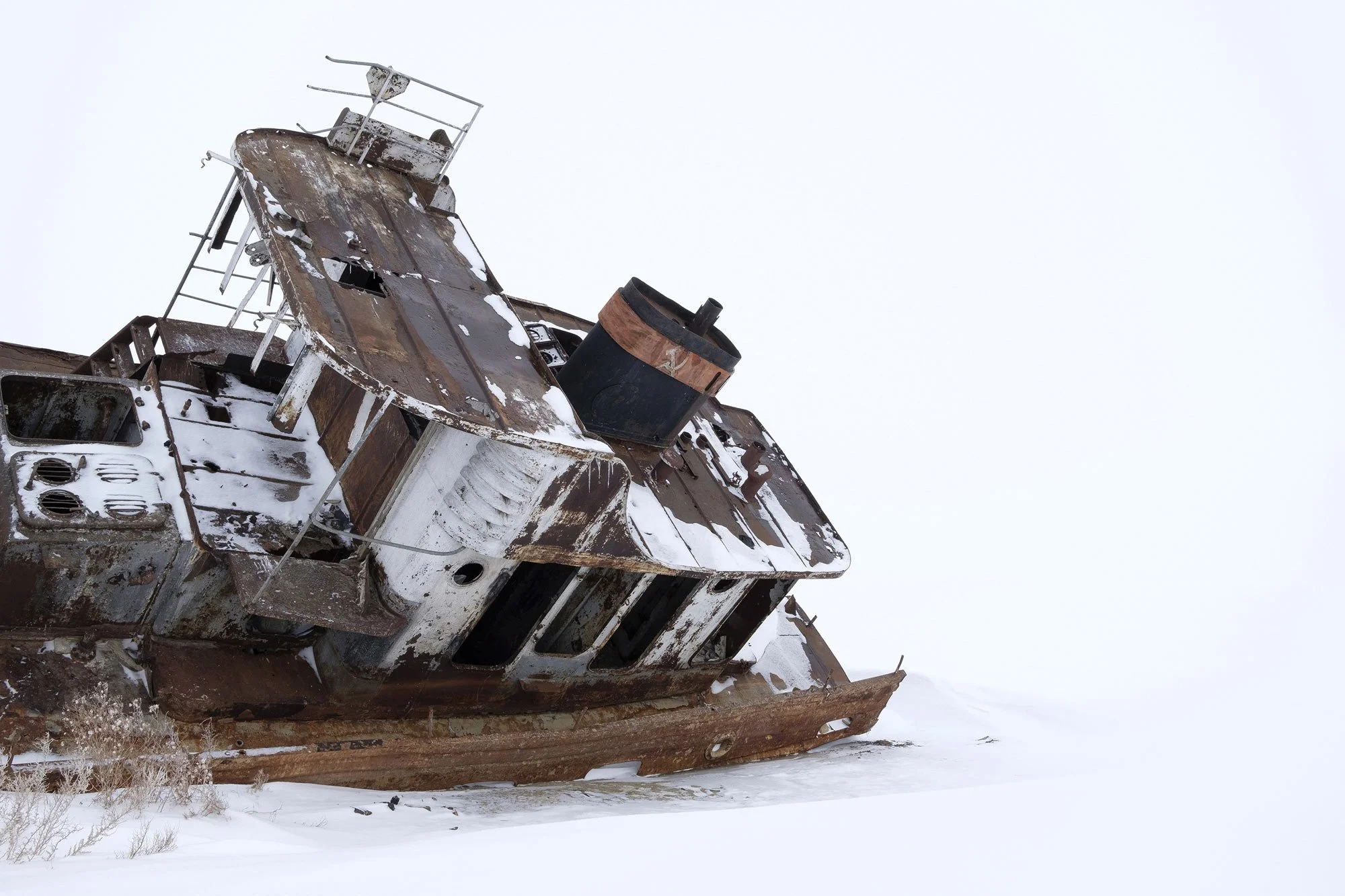
Of the once-famous shipwrecks seen around the world, only two boats remain. They will disappear within six months, marking the end of tourism on the Aral Sea. In winter, with temperatures reaching –20°C, access to the boats becomes extremely difficult; only VAZ jeeps can make it through. Higher and lighter, they struggle across the frozen, snow-covered Aral Sea.
Tastubek, February 2017, Kazakhstan
HM: The world of photography is changing rapidly — especially with new technologies like AI. How do you feel about this transformation?
DB: I’m completely open to it. I accept 100% that change is happening — whether we like it or not. You can fight against it, but you’ll lose. So my attitude is: why not explore it?
I actually created a project last year using artificial intelligence. It was fun — playful, experimental. And of course, some photographers criticized me: “You’re using machines instead of cameras!” But I reminded them that 150 years ago, painters were furious at photographers. They said, “You’re killing painting!” And yet, photography became its own art form. When the Polaroid arrived, traditional film photographers criticized it. When computers replaced manual photogravure at the end of the 1980s, many did not adapt and lost their clients. The same happened with digital photography, which today has given an incredible new strength to film photography. In the end, everything comes back into balance. But, we must be careful — especially with deepfakes and synthetic “real” images. That’s dangerous. But AI also brings an enormous amount of creativity. It can push us to think differently, to imagine differently.
I believe AI will force photographers to be more inventive, to redefine what authenticity means. That’s not a bad thing.
HM: A few weeks ago, I attended a lecture by the legendary fashion designer Norma Kamali, who was enormously successful in the 1970s and ’80s. She spoke about her new work — and what fascinated me was how openly she discussed her use of AI in her creative process.
She explained that she had uploaded her entire archive — every design she has ever created — into an AI system. Then she asked the AI to reinterpret her visual language, to build upon her creative DNA and generate new ideas: fresh, unexpected, and contemporary.
I thought that was incredibly brave. She could have kept it secret — no one would have known. But instead, she stood on stage and said, “Yes, I used AI — and it helped me evolve my creativity.” That kind of honesty felt both refreshing and inspiring.
DB: Exactly! That’s what’s truly interesting — it’s not about replacing the artist; it’s about collaborating with a new tool. The machine becomes a mirror, reflecting your imagination in surprising ways. I believe the future of photography will be less about the camera and more about vision — how you see, how you interpret, how you create meaning.
The tools will change, but the desire to express, to observe, and to understand — that will always remain the same.

The Reborn Dolls Fair in Valencia, Spain has just opened for three days. The jury is reviewing the dolls on display for the competition.
April 27, Valencia, Spain
HM: Beautifully said. It seems your work — and your philosophy — always return to the idea of questioning reality, while preserving the human element.
DB: Yes. Because in the end, even in a world full of lies, illusions, and algorithms, we still need emotion. That’s the one thing machines cannot imitate — human doubt, hesitation, imperfection. And that’s where photography still belongs.
Creativity has never been about the tools; it’s about what you do with them. If something can enhance our creativity, challenge our imagination, or open new directions, why not use it?
The problem begins when people are dishonest — when they present AI-generated images as purely human work, or when it’s used to deceive, especially in journalism and information. I’ve seen newspapers and magazines publish images that were clearly AI-generated or heavily manipulated, presented as real photojournalism. That is deeply disturbing. Transparency and ethics are essential.
HM: Exactly — that’s the real danger. But in terms of creativity, perhaps AI can also bring something new. After all, we’ve been stuck in repetition for quite some time.
DB: I agree. If you look at creative history — from the 1900s to the 1930s, there was an explosion of innovation in cinema, architecture, and the arts. Then the 1950s, ’60s, ’70s, even the ’80s — each decade was full of energy, rebellion, and invention. But since the 1990s, it has become harder to point to something truly new.
Maybe the integration of artificial intelligence will spark the next major creative revolution. Perhaps it will change how we think, how we make images, and how we imagine the world. I hope so…

On the main road in Kyzylorda, a giant sculpture stands on the side of the road.
February 2017, Kazakhstan
HM: Do you feel that beauty itself is changing in photography?
DB: Beauty has always been important in photography — it helps us engage with difficult or unsettling subjects. But today, I find something troubling. People go to war zones — in Ukraine, for instance — and share their photos on social media. Because of the technology we now have, the images are beautiful.
But what are we really looking at? Maybe a dead body, maybe soldiers firing weapons — and people comment, “What a beautiful photo.” That makes me angry. The technical perfection of our cameras can make even horror appear aesthetic, and that distorts how we perceive reality.
Still, beauty matters. Even a mine, a place of destruction, can be photographed beautifully. My goal is to make meaningful images — pictures that are both beautiful and purposeful.
Actually, I’m not even sure what beauty is. It’s something deeply personal — each person must define it for themselves.
HM: So what makes a “Good photo” for you?
DB: For me, a good photograph must have two essential elements: meaning and composition.
A photo without meaning is empty; a photo without strong composition is weak. Both must coexist.
Good framing gives structure to emotion — it helps the image communicate its message. Every photograph I take must be justified. I can’t take a picture just because it looks good. Maybe it’s my background in advertising, but I always ask myself: Why am I taking this image? What is it saying?
Of course, sometimes we all shoot instinctively, but generally, I need a reason — something behind the image that gives it life. A “nice” photo, to me, is one that resonates internally — when something in my mind vibrates and tells me, yes, this is right.

Portrait of Akerke, a young farmer who recently moved from the city of Aral, at her home.
April 2016, Kazakhstan
HM: You’ve worked on many projects. How do you start something new? How do you organize yourself?
DB: Like many photographers, I begin with research. I read about the country or subject I plan to photograph, watch films, and try to understand the history and culture. I even read local newspapers — with Google Translate if necessary — to sense what people are thinking.
Before traveling, I always find a local guide or fixer who knows the terrain. Preparation is crucial — arriving unprepared is disorienting.
But once I’m there, I work spontaneously. That’s when I truly feel like a photographer. I rarely shoot in France; I start taking pictures when I’m on location, immersed in a story. Spontaneity, intuition, and openness — that’s essential.
It’s like acting: you have to forget your own world and live inside the one you’re documenting.
HM: Imagine you’re speaking to a hundred photography students at a university. What advice would you give them?
DB: My first advice is simple but difficult: be yourself.
Don’t imitate your favorite photographers or follow Instagram trends. Frame your image the way you see it, even if others find it strange. Authenticity is always stronger than imitation.
Second, be creative. Many documentary photographers forget that creativity matters. They think reality doesn’t need interpretation, but creativity is what transforms observation into art.
If you see a subject everyone else is photographing, maybe you shouldn’t. Turn around — look 180 degrees. Find the angle no one else sees. That’s something I learned in advertising: never do what everyone else is doing.
It’s not easy to be different — but that’s the point. Our challenge is to find a voice that’s unmistakably our own. Even today, I question my own approach constantly. Doubt can be painful, but it’s necessary if you want to move forward.

The largest cruise ship in the world, with 9,000 people on board, has just docked in Charlotte Amalie, St. Thomas, in the Caribbean. Two-thirds of the passengers will disembark to enjoy excursions.
Miami, March 2019, USA
HM: Has your work ever been rejected for being “too different”?
DB: Yes, absolutely. A few years ago, an editor told me, “This isn’t the kind of photography we publish.” It wasn’t criticism — just that my work didn’t fit their visual language.
My photos are often flat and staged, almost like theater scenes. They exist somewhere between documentary and art photography — which can confuse people. Galleries find them too documentary, and newspapers find them too artistic.
But that’s fine. I prefer to exist in that in-between space. That’s where my voice is.
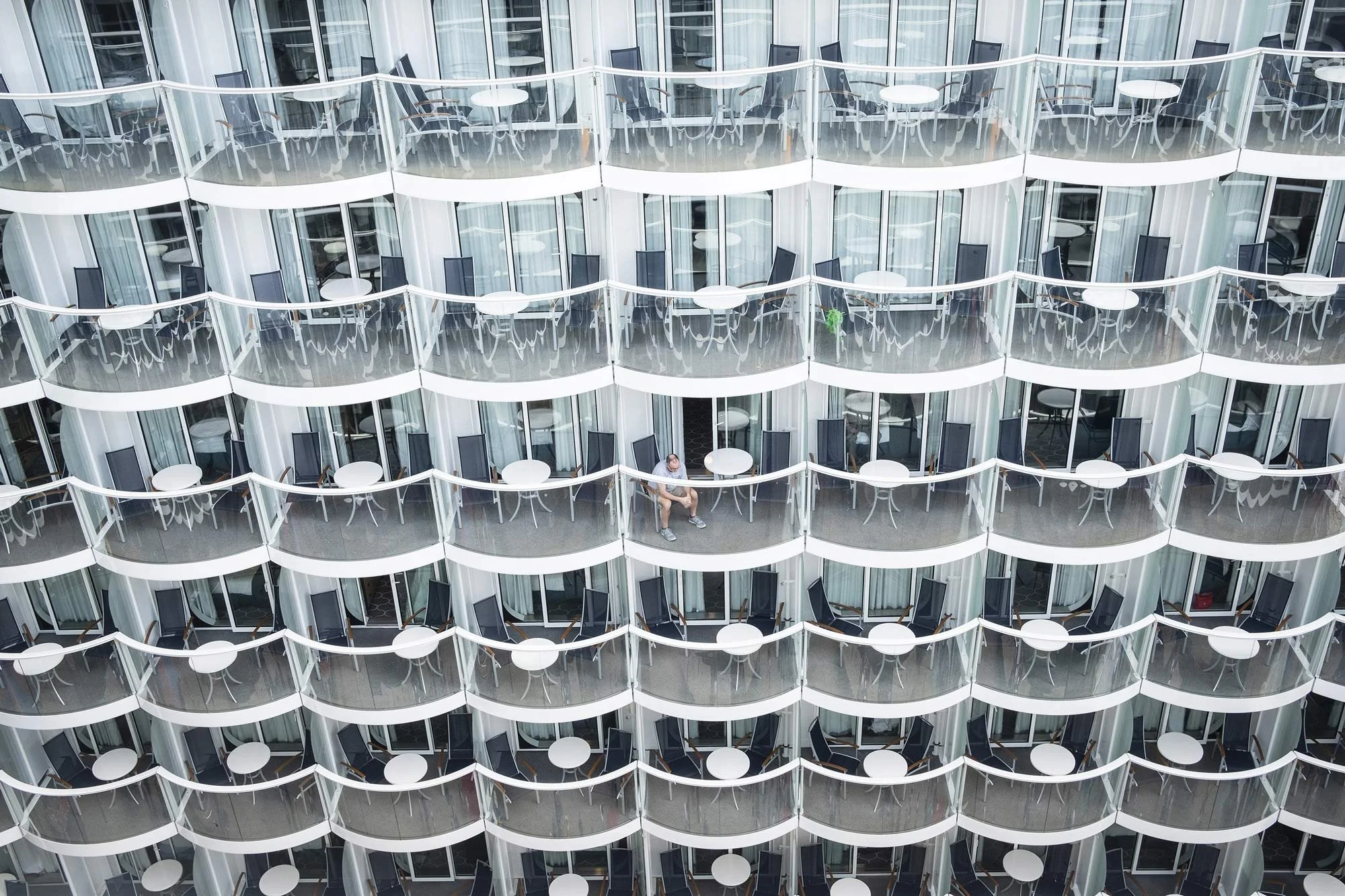
The ship has just left Miami. One passenger chose to stay alone while everyone else is on deck. The cabins are either with or without a balcony, inside or outside the ship.
Miami, March 2019, USA
HM: You mentioned creativity — do you think it’s been missing in recent decades?
DB: Yes. The most creative eras — the 1950s through the 1980s — were extraordinary, not only in photography but in music, art, and culture. Since the 1990s, it’s been harder to find true innovation.
Maybe this new technological wave — AI, digital manipulation, new storytelling forms — will bring back that spirit of experimentation. If it helps us question what an image is, or how we see the world, then it’s a good thing.
HM: You’ve spoken before about technology and its role in contemporary photography. How do you see artificial intelligence shaping visual art?
DB: There’s no point fighting it. Technology is part of our world now — artists need to live with it, or better yet, use it creatively. Many people criticize AI because they fear it or don’t understand it. But photography itself was once a new technology — and it changed everything.
AI is simply another tool, another way to construct images. The language is different, but the vision remains human. Some AI-generated works I’ve seen are extraordinary. They open new possibilities for storytelling and imagination.
HM: You’re currently working on a project in the Czech Republic. Can you tell us more about it?
DB: Yes. I’m spending about a month here on a state grant, revisiting a country I first lived in during the 1990s. Back then, I wasn’t yet a photographer. My wife and I used to travel through the Bohemian and Sudeten regions, visiting places connected to her family’s history. Her grandparents were German and were expelled from Czechoslovakia after World War II, along with millions of others.
Now, 35 years later, I’ve returned to retrace those journeys — but with a deeper understanding of history. I’m collaborating with a historian to locate key sites, aiming to give new meaning to these landscapes by connecting memory, history, and contemporary vision — from 1938, when Hitler occupied the country, to 1989, when the Russians left.
It’s a kind of historical road trip — blending digital and film photography, artificial intelligence, photo montages, and cross-stitch embroidery. A hybrid project that’s part documentary, part personal reflection — poetic, sensitive, experimental, and, above all, hybrid.

Two teenage girls arrive at the old cable car station in the city of Yalta.
July 2016, Crimea
HM: How are you using artificial intelligence in this project?
DB: One example is a series inspired by the death march of 1,300 Jewish women who were forced to walk 800 kilometers from Poland to Czechoslovakia in 1945. Only about 350 survived.
I’m photographing the landscapes they crossed — forests, fields, paths — and using AI to generate a sequence of women’s shoes from that era. The first pair appears new and intact; with each subsequent image, the shoes deteriorate, until by the thirtieth image, they are completely destroyed.
It’s a simple but powerful metaphor for endurance and suffering. AI helps visualize what history has left invisible — those traces of horror hidden in the beauty of today’s landscapes.
HM: The Sudetenland remains a sensitive subject. How have locals responded?
DB: It’s still difficult to discuss. The Sudeten Germans were expelled after the war, and many were killed in the process. Even today, Czechs prefer not to talk about it — the wounds are deep: historical, emotional, and political.
Historically, the Sudeten region was part of the Austro-Hungarian Empire, with a large German-speaking population. After 1918, when Czechoslovakia was created, many Germans felt marginalized. When Hitler rose to power, some welcomed him, hoping for protection — a decision that ultimately brought disaster.
After 1945, nearly three million Germans were expelled, and the violence was horrific on both sides. These are difficult truths, but as an artist, I believe it’s important to confront them with empathy and honesty.

Galbadrakh and Terbish are 30-year-old breeders. They have three children. Their camp is located 14 km from the town of Tsetserleg. The animals have returned for the night, and it is time for the family to take a break before going to bed.
Tsetserleg, May 2018, Mongolia.
HM: You and your wife also run a publishing house. How did that begin?
DB: Yes, we started a small publishing house together. My wife founded it first, and I later joined to handle design and layout. So far, we’ve published about twelve books, and we plan to release three more next year. We move slowly, but carefully.
It’s deeply rewarding to hold a finished book in your hands — knowing it will outlast any exhibition.
HM: Beyond this current project, what’s next for you?
DB: I have a few ideas. One focuses on people who believe in UFOs or claim to have experienced supernatural visions. I’ve already begun photographing and interviewing some of them. One woman told me she saw the Virgin Mary as a child. I recorded her story and used AI to generate an image from her description.
The result was extraordinary — not because of the computer, but because it visualized her imagination. I’d like to continue this series across France, meeting more people who believe in things beyond the visible world. But I’ll need to find funding — perhaps another grant.
In this project, AI becomes a bridge between belief and reality. It allows me to make visible what people feel, remember, or dream. That’s the most exciting thing about it.

A woman is sitting in a vintage Soviet café in the city of Saint Petersburg.
September 2018, Russia
HM: That’s a beautiful way to put it — AI as a bridge between belief and reality.
DB: Yes, exactly. It’s not about replacing the artist — it’s about expanding imagination. The machine doesn’t dream, but it can help us see our dreams more clearly.
All images © Didier Bizet