
Marco Claudio Campi - “The Camera Is Not a Barrier, It’s a Bridge”
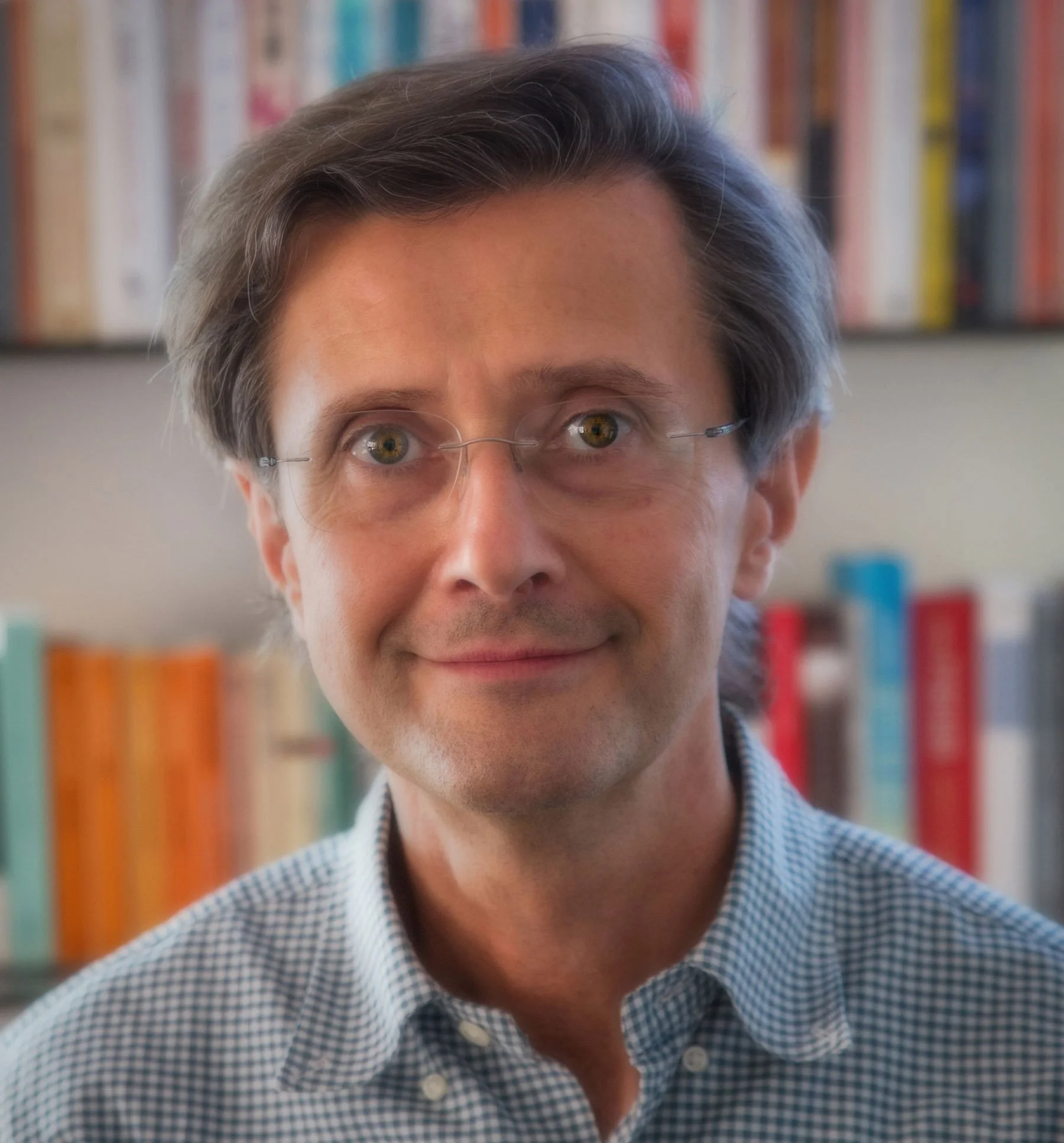
Marco Claudio Campi is an Italian photographer and academic based in Milan. For over two decades, he has worked on social and environmental themes through street and documentary photography, often developing long-term projects across Europe and Asia. His work is frequently rooted in direct personal experience, including his long-standing engagement with India, which began during scientific work in Bangalore in 1997.
His projects include The Sinking City, on climate change in Venice, and Diary of a Pandemic, produced in Milan’s Monumental Cemetery during Covid-19 and published as a photobook in 2023.
Campi’s photography is closely linked to his academic research in inductive reasoning: just as his scientific work builds structures from observations, his photographic practice brings together individual images to reveal wider patterns and meaning. He teaches and lectures internationally in inductive learning and is affiliated with the University of Brescia.
HM: You come from a background in mathematics. How does that connect if at all to your photography?
MCC: At first, they seem very far apart. Mathematics is rigorous, abstract, and structured. Photography is intuitive, emotional, and open.
But for me, they are deeply connected.
My work in mathematics revolves around inductive learning and how we construct models of the world from observations. This is a fundamental question: how do we go from individual experiences to general understanding? How do we trust that what we observed in the past can help us interpret the future?
Photography works in a very similar way. Each photograph is a fragment, a single observation. On its own, it is incomplete. But when you place images together, they begin to form a narrative, a kind of model of reality.
In mathematics, this process is formalized. In photography, it is left to the viewer. The viewer connects the dots, fills the gaps, builds meaning. So although the tools are different, the underlying question is the same: how do we move from the particular to the universal?
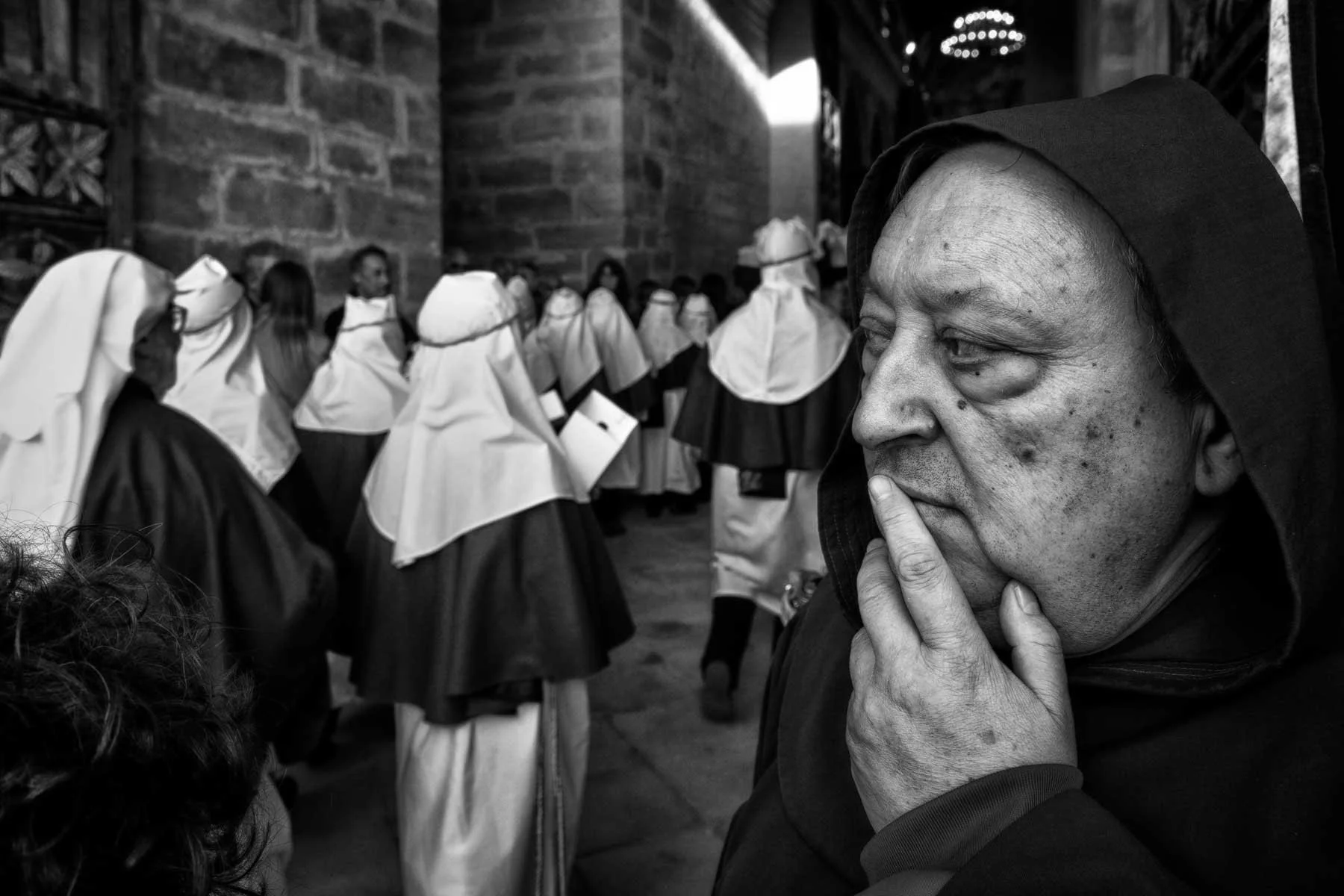
Monk’s Gaze
A monk observes the advancing procession.
HM: Tell us a bit about your early life. Where did it all begin?
MCC: I grew up in Milan, in a very ordinary middle-class family. My parents lived through the Second World War as children. My father was a technician, my mother worked until she decided to dedicate herself to the family.
We lived on one salary. Money was tight, but as a child, you don’t really notice that. What mattered was that we had everything essential: education, stability, and care.
Looking back, it was a simple life. But a good one.
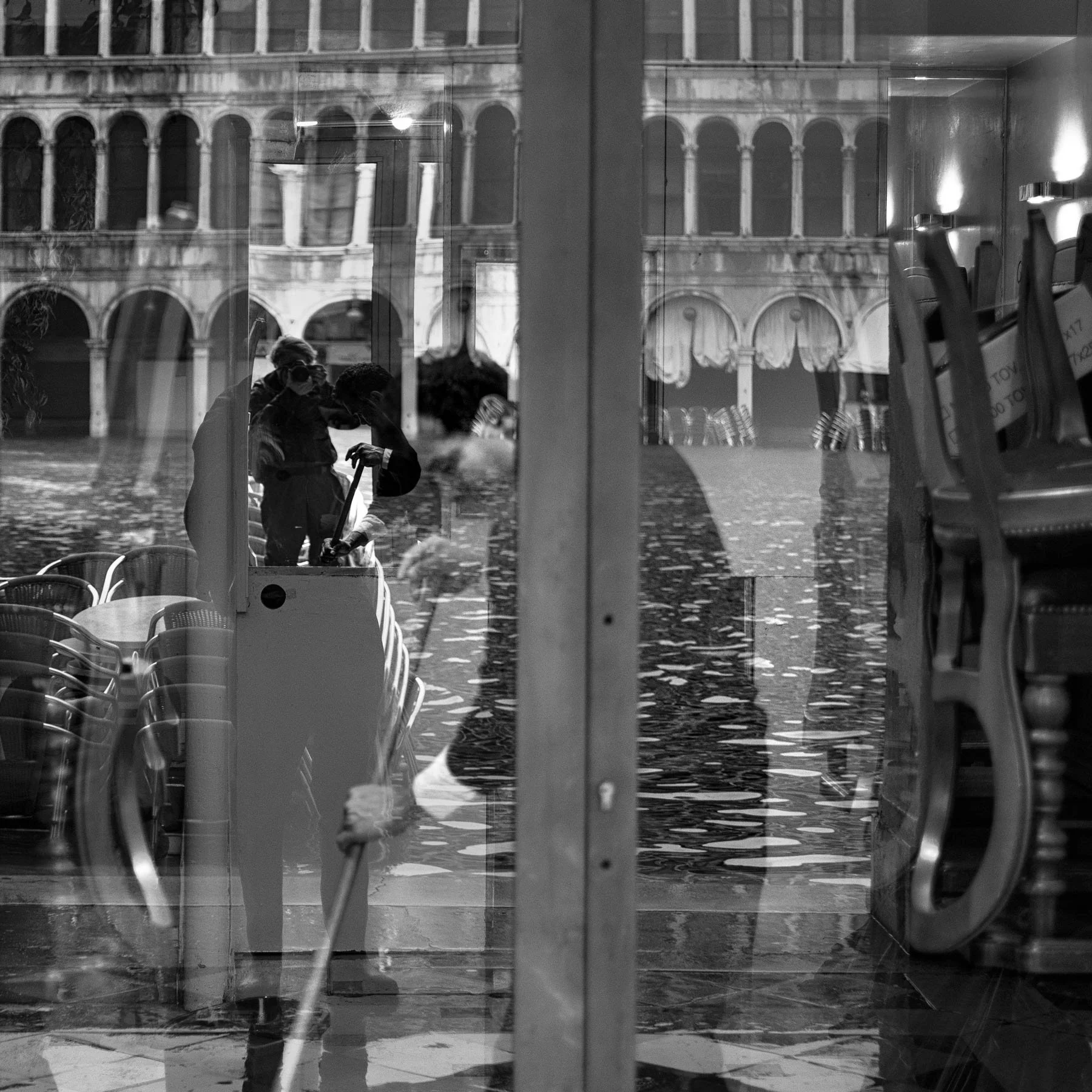
Laborious Hands
November 17, 2019
Venetians cannot be bent that easily, everyone that has had a contact with this city is aware of this. At a point, my attention was caught by this multilayered vision that evolved around a man’s hands working hard to clean a shop in piazza San Marco. A symbolic tribute to the Venetians' determination.
HM: You often describe your life as “ordinary,” yet your work explores very intense realities. How do you see that contrast?
MCC: I believe the ordinary is necessary.
My daily life is structured and predictable: teaching, reading, and working at my desk. It is stable. And precisely because of that, I can go deeper when it comes to cultural exploration.
Photography is my way of stepping outside that structure. It allows me to enter different worlds, to experience things that are far from my everyday life.
Being ordinary in daily life makes time for depth.
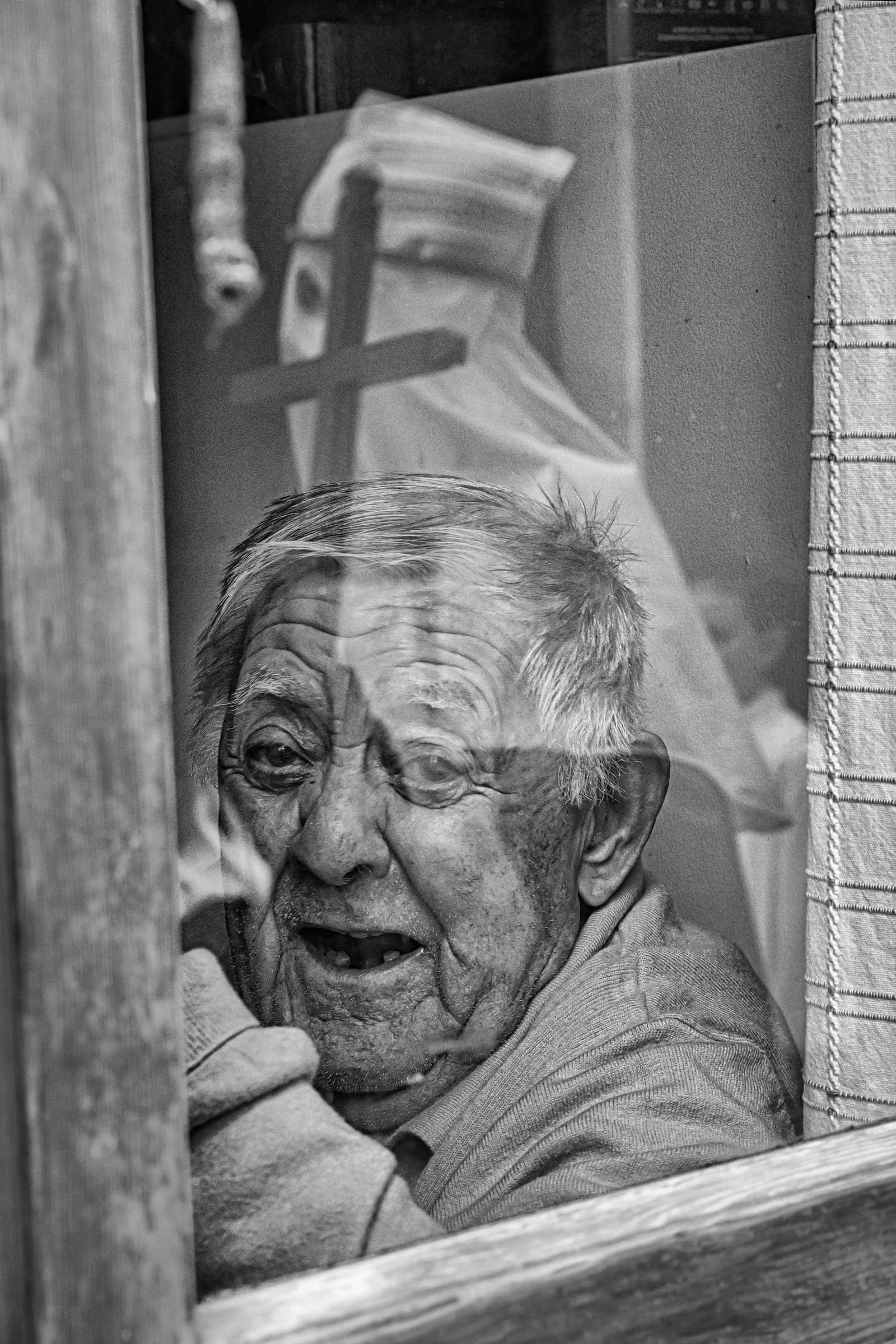
Through the Glass
An elder observes the procession in anxiety.
HM: When did photography become a serious part of your life?
MCC: I started very young around 14 when I got my first camera, a Canon AE-1. But for many years, photography was something I approached quite casually.
It became central about 20 years ago. Not as a decision, but as a realization.
I understood that photography was a powerful way to explore the world. With a camera, you engage differently. You look more carefully, you connect more easily with people, you become more attentive.
It is not something you plan, it grows on you.
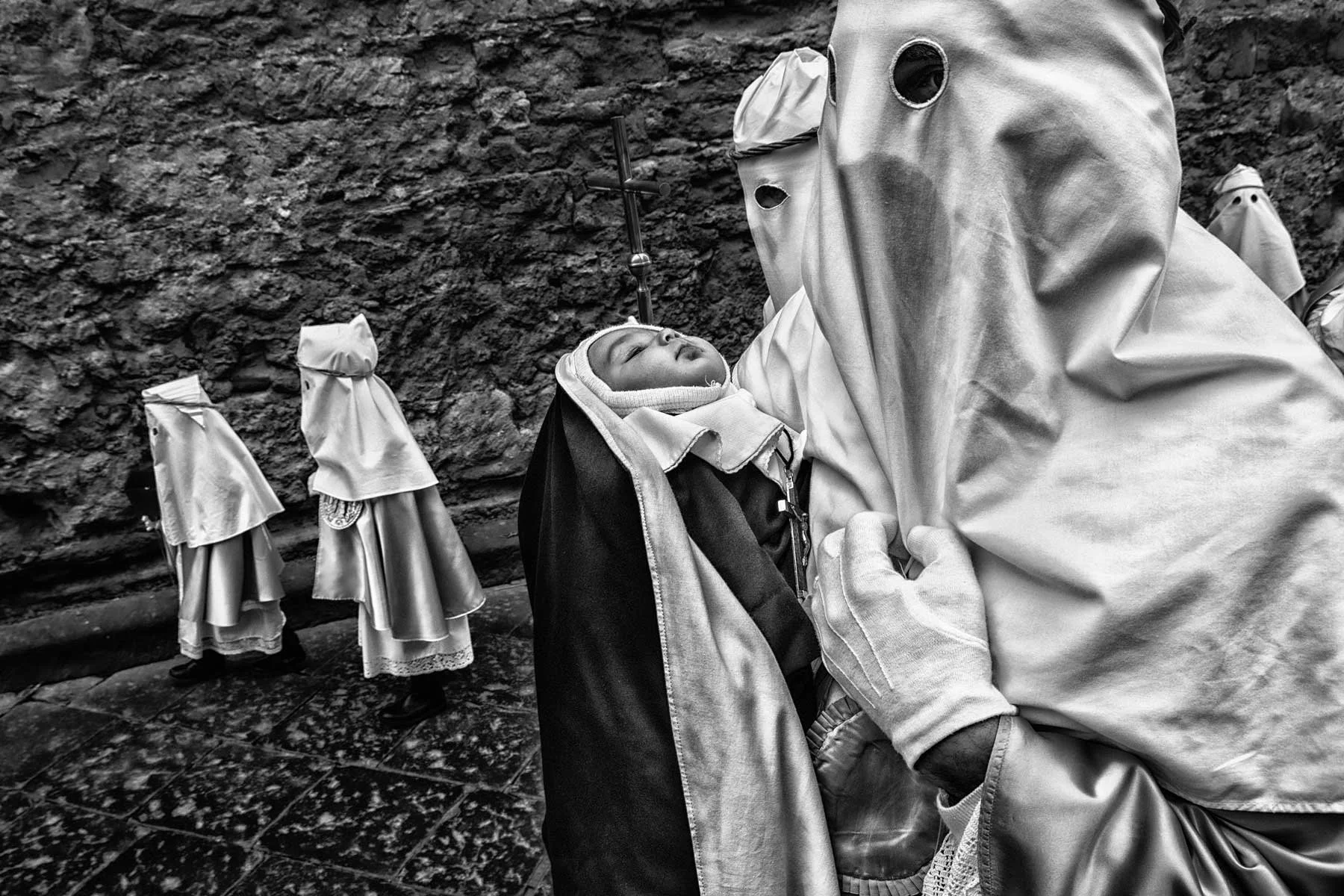
The Unveiled
The smallest presence, and the only face.
HM: Many people think photography distances you from experience. Do you agree?
MCC: No, I think it’s the opposite.
The camera is not a barrier, it's a bridge.
Without it, you might look at something but not truly see it. With it, you are forced to observe, to search for meaning, to engage.
Also, it creates connections. Before taking a photograph, you often speak to people, you establish a relationship. In my experience, very few people refuse to be photographed.
Photography brings you closer to reality, it does not take you away from it.
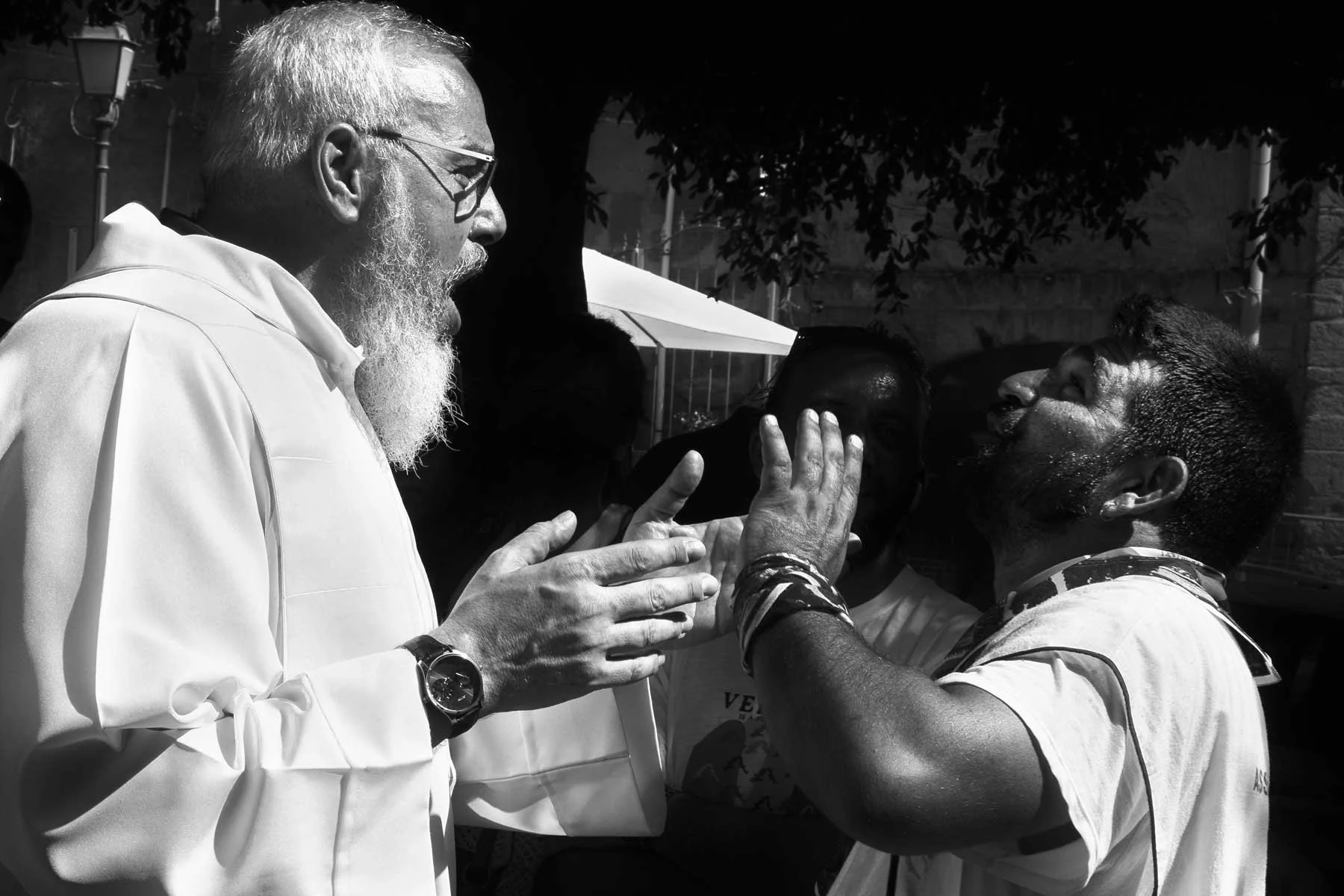
Vuci di Sapienza
The parish priest booms at a follower.
HM: Does photography change the way you relate to people?
MCC: Very much.
My wife says I become a different person when I’m photographing. I’m more open, more curious, more willing to engage.
I smile more. I speak to strangers. I listen.
Some of my most meaningful encounters have come from photography—not even from the images themselves, but from the interactions that happen around them.
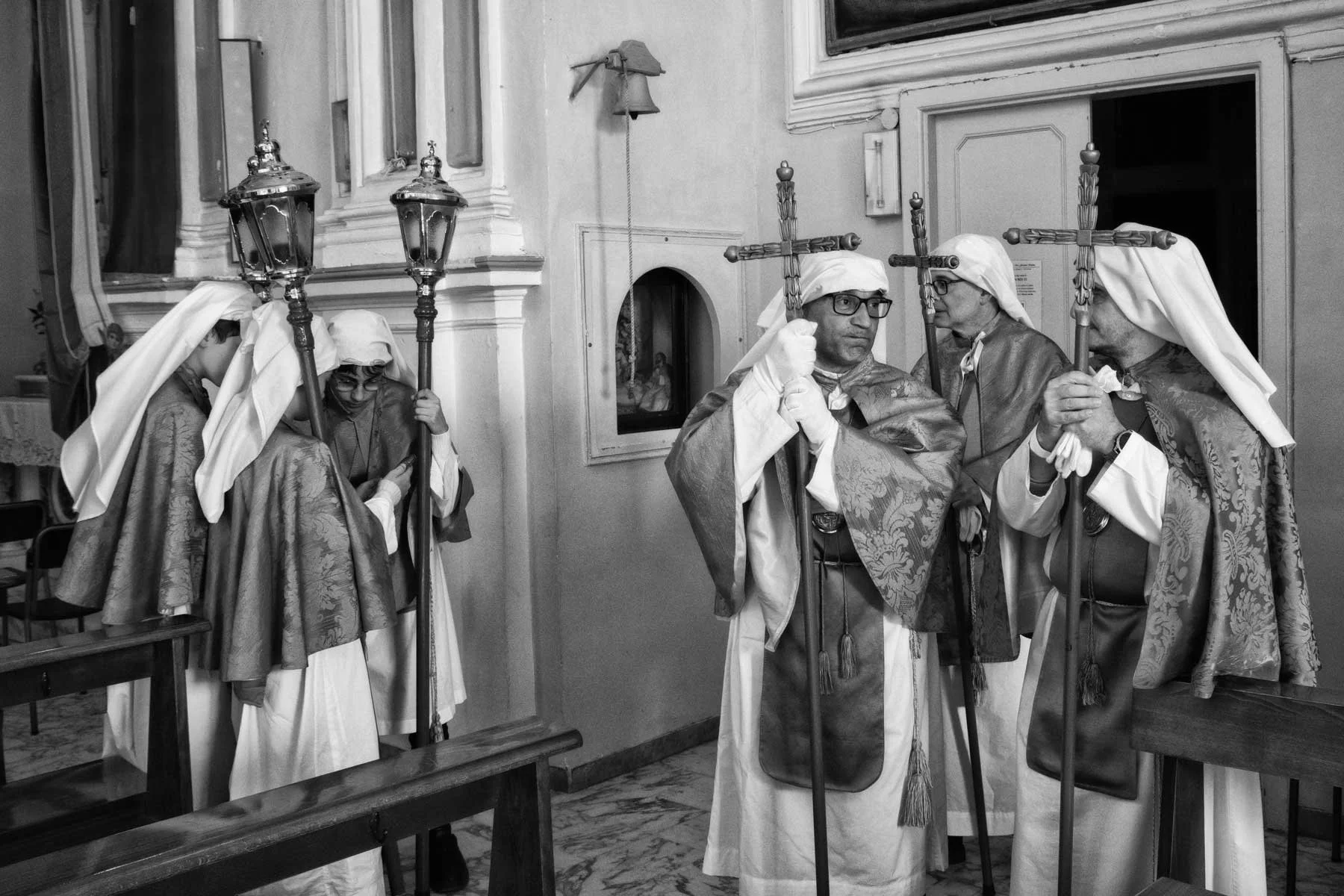
The Human Beneath the Habit
Older confratelli watch a group of younger ones, caught up in a mobile phone: the Bologna–Inter match deciding the Italian championship has just started.
HM: You said something striking: photography is freedom. What do you mean by that?
MCC: Photography is freedom in the sense that you are free to explore.
I remember walking in India, alone, immersed in the environment, and suddenly feeling deeply happy. It’s not a feeling I experience often, but in that moment, it was very clear.
That feeling came from freedom: the freedom to observe, to move, to engage with the world through the camera.
Of course, this is also a privilege. I have a stable academic career, so I can choose what I photograph. If you work on commission, you have constraints.
But true photography requires freedom. Without it, something essential is missing.
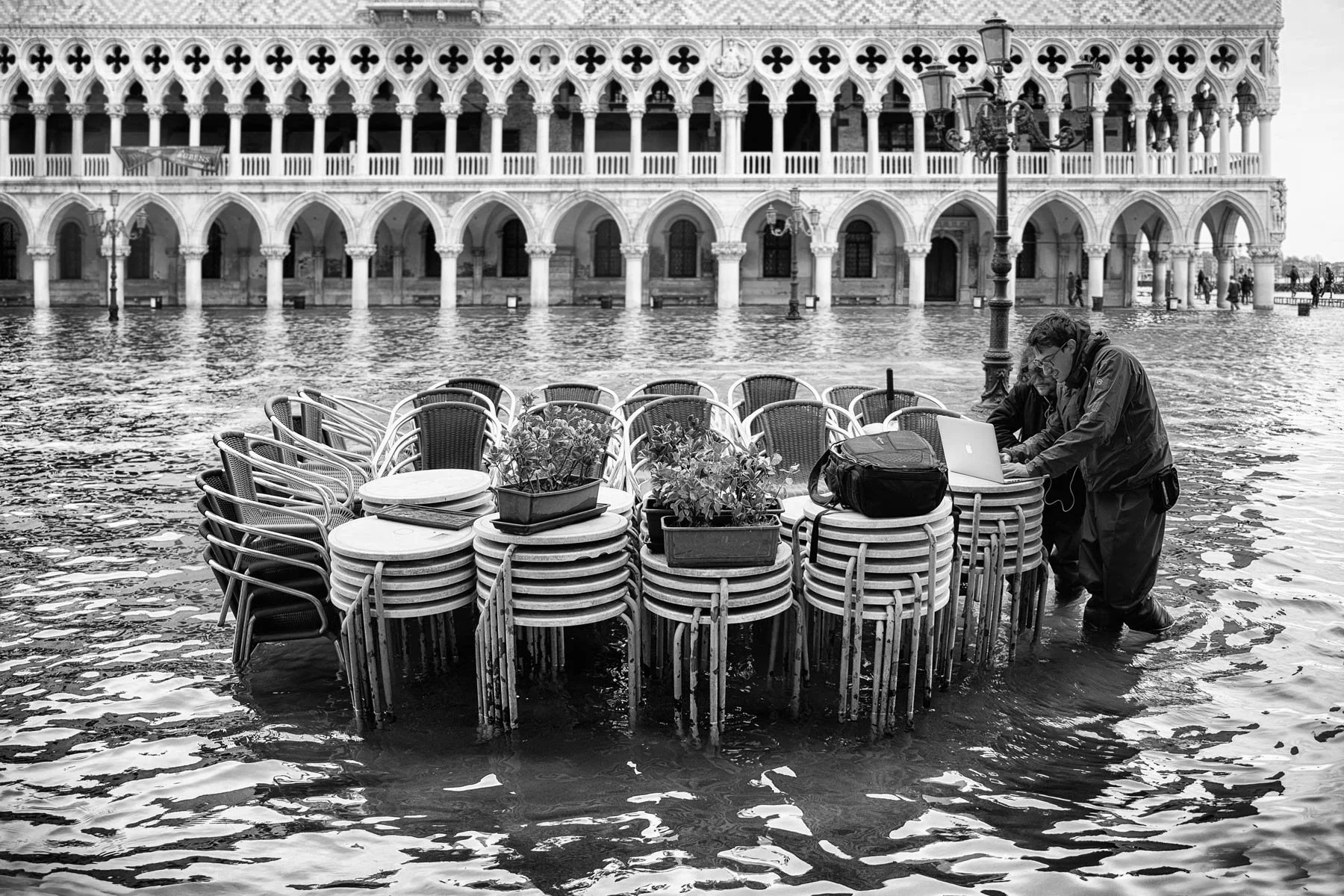
In Spite of Everything
November 17, 2019
It was kind of startling seeing those two guys working with their laptop in that uncomfortable situation.
HM: Do you photograph to understand the world or to understand yourself?
MCC: Both. But it starts with the world.
At first, you are driven by curiosity. You want to understand people, cultures, and situations.
But over time, you realize that what you choose to photograph says something about you. Your interests, your sensitivities, your questions.
So photography becomes a mirror. You think you are documenting the world, but you are also revealing yourself.
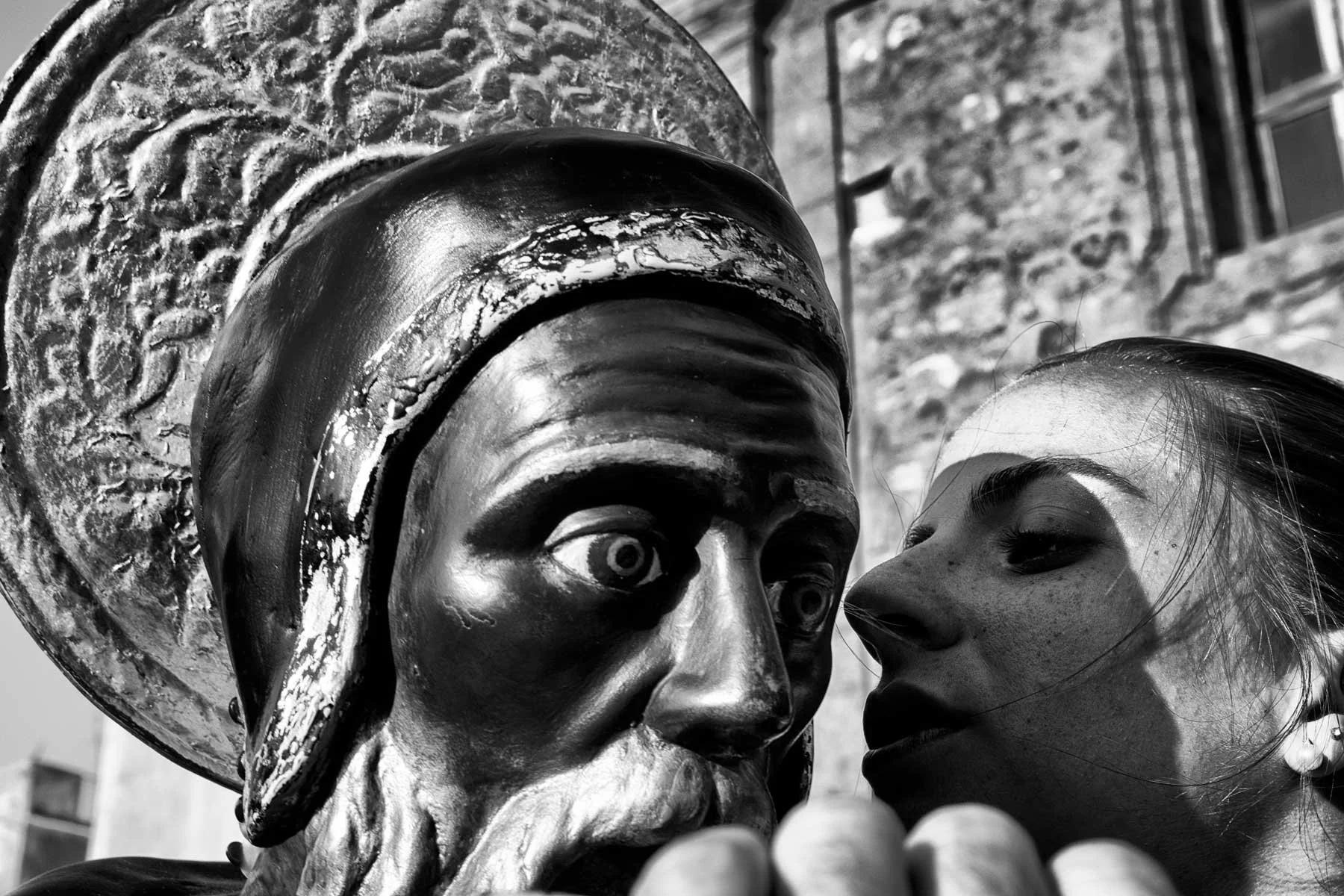
Tinnirizza e Statu
A young woman leans in to kiss the statue of San Calogero.
HM: You often photograph deeply religious moments. Do you feel like an outsider, or do you become part of it?
MCC: I remain an outsider in terms of belief, but not in terms of experience.
I do not share the same religious conviction, but when you are there, surrounded by devotion, you cannot remain untouched. There is a collective energy that is very powerful.
So I do not become a believer, but I become involved. Emotionally, yes.
And I try to translate that intensity into images.
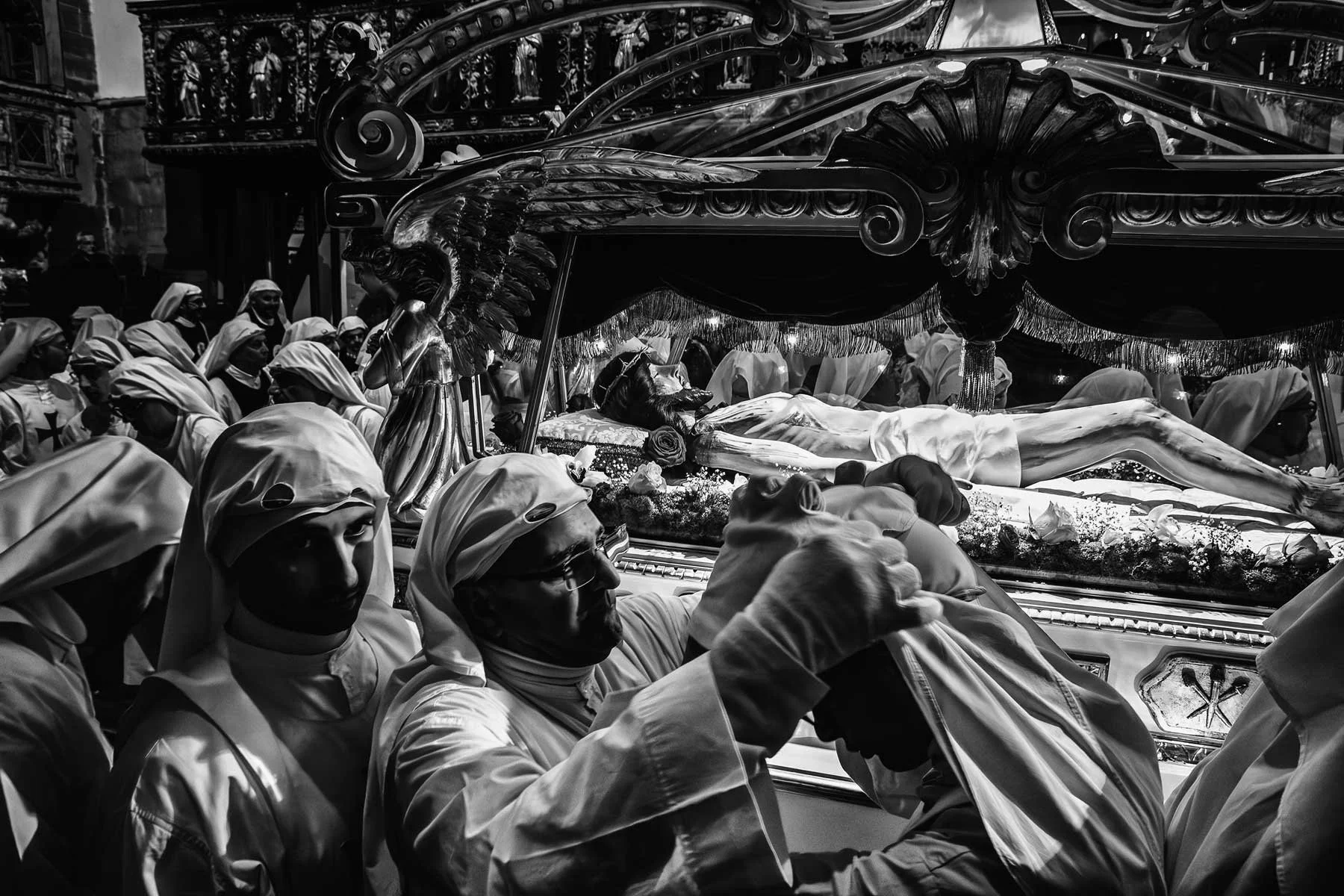
Good Friday
The body of the Dead Christ rests in a glass coffin. The Good Friday procession will last for many hours after sunset, with devotees following in prayer.
HM: What drew you to photograph religious festivals in Sicily?
MCC: It was a shock, in a positive sense.
Coming from Northern Italy, I thought I knew my country. But Sicily revealed something completely different, more intense, more physical, more emotional.
These festivals are not performances. People are fully engaged. They carry heavy statues for hours, they struggle, they cry, they celebrate.
There is something deeply authentic in this participation. It feels almost outside of time.
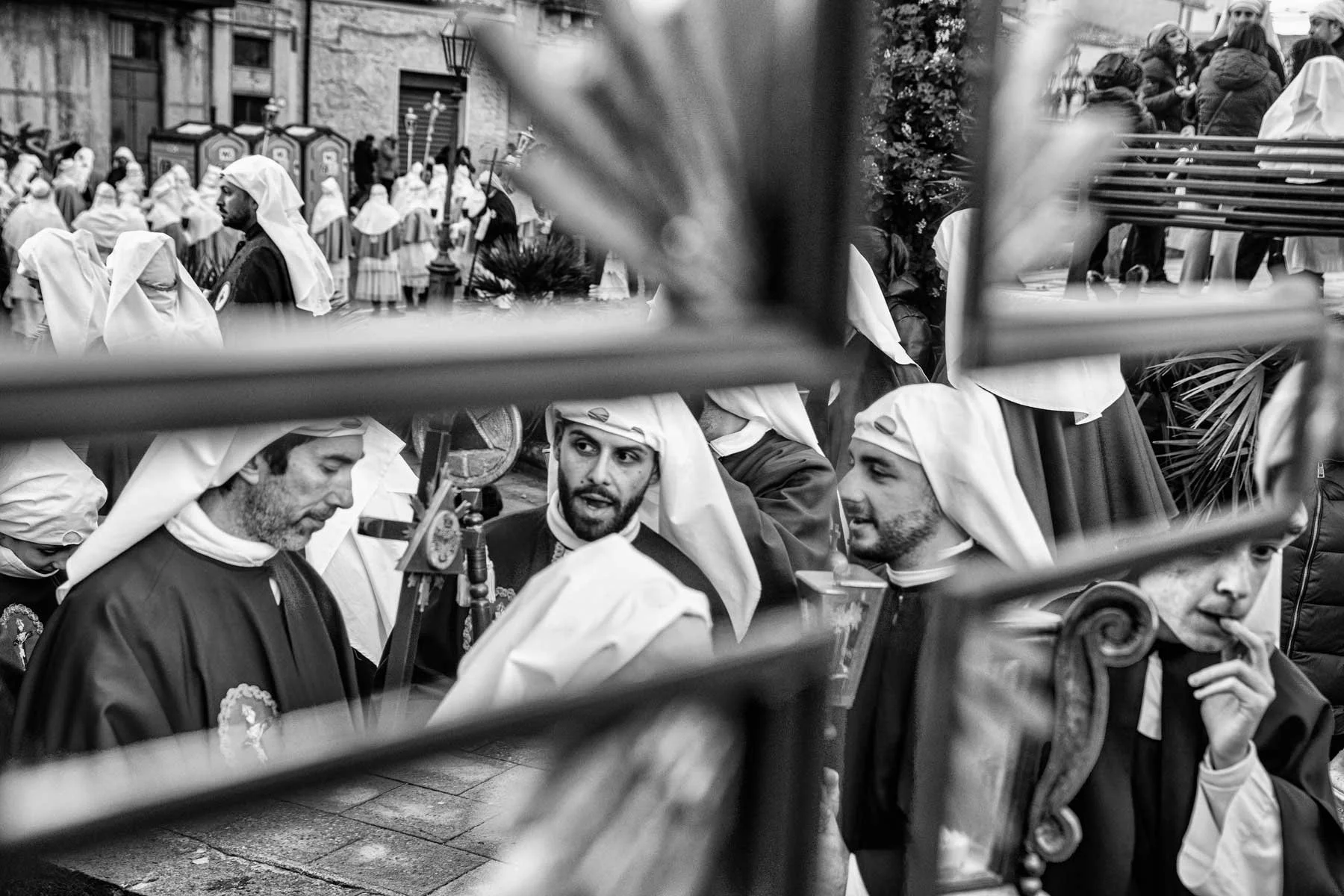
The Cross
The crowd assembles in Piazza Mazzini during preparations.
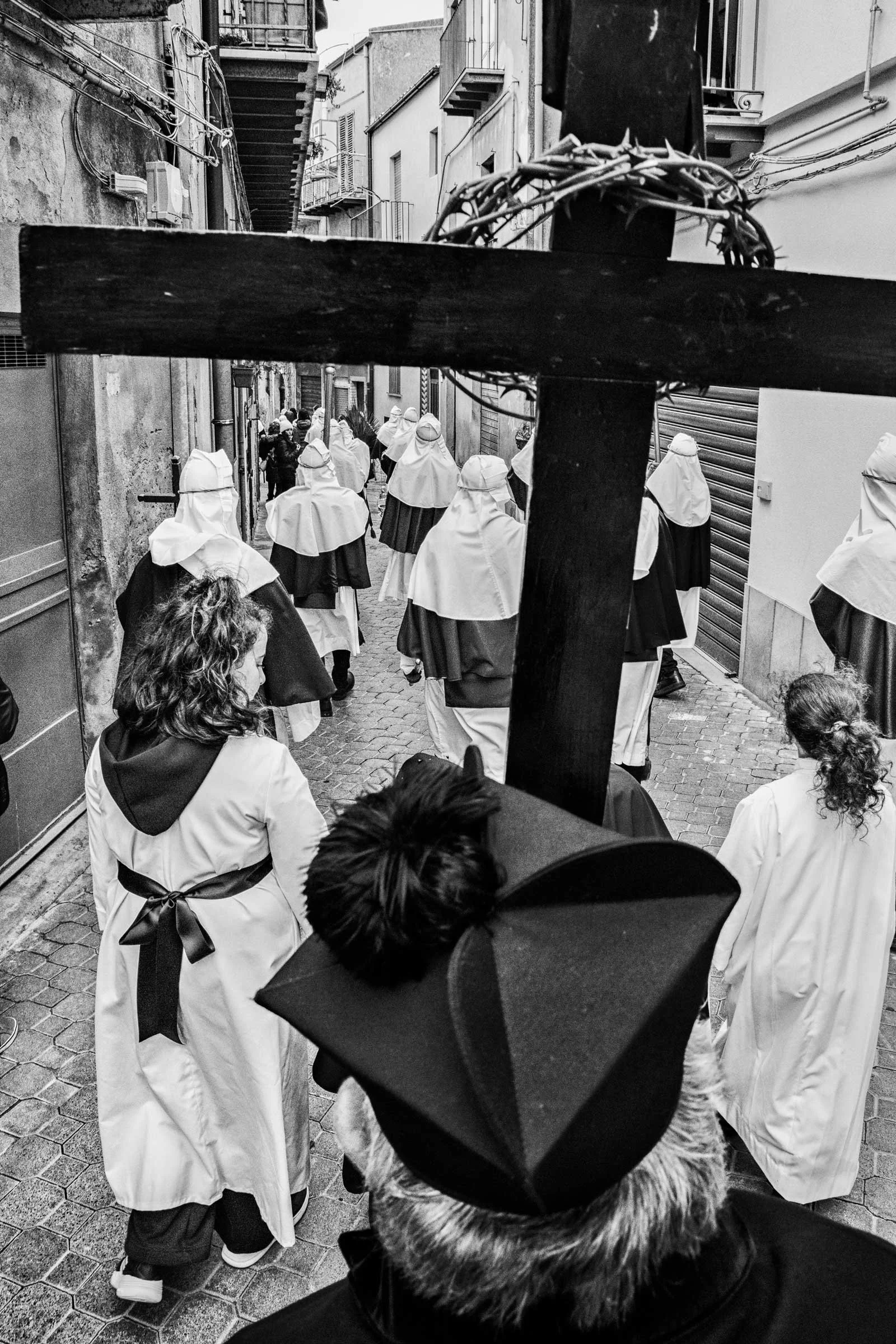
Tuesday’s Procession
A procession meanders through Enna’s narrow alleys.
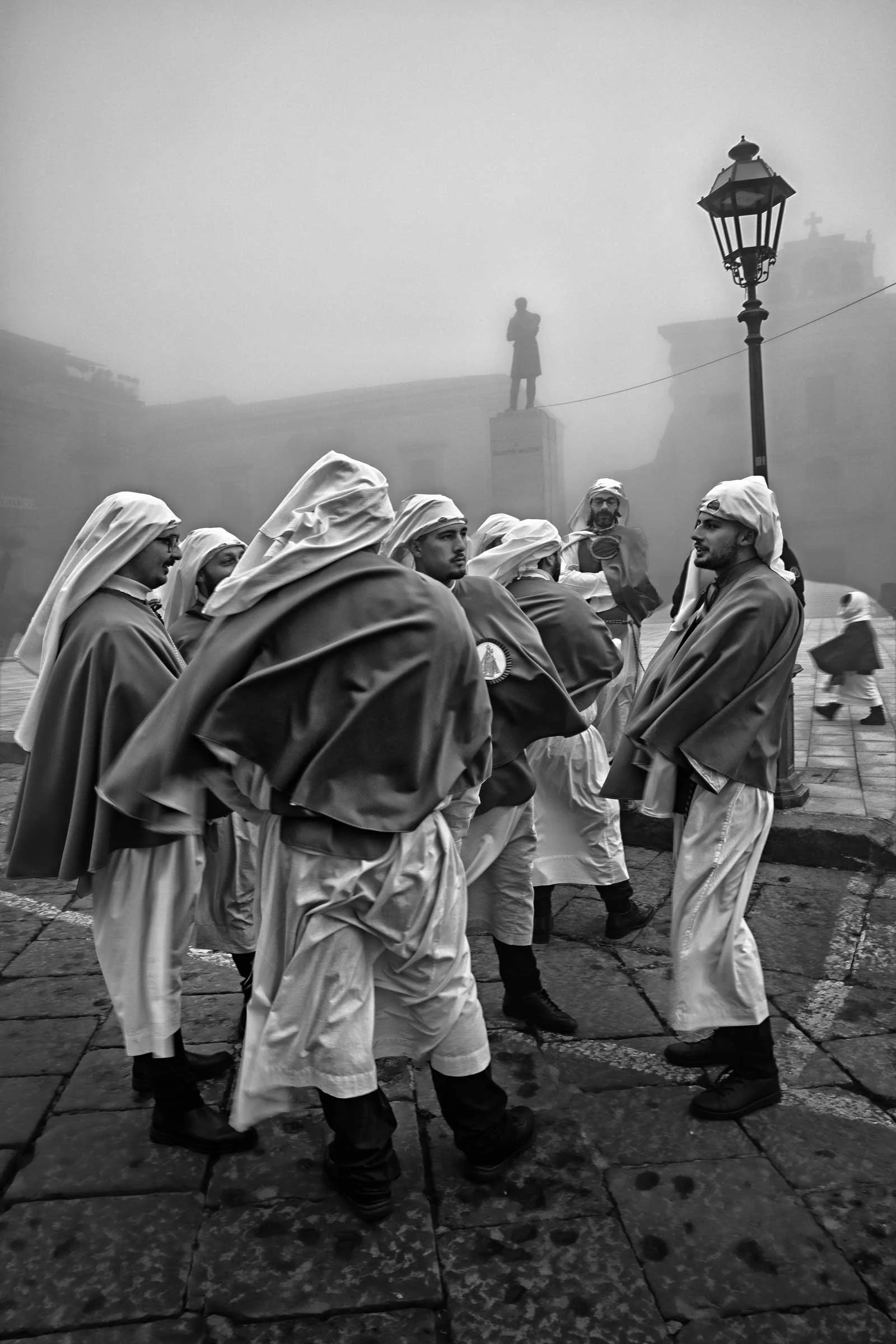
The Respite
A group of young confratelli gathers in the wind during a moment of rest.
HM: Your images from Sicily feel almost medieval. Is that intentional?
MCC: Not intentional, but it happens naturally.
There are moments where everything aligns the gestures, the atmosphere, the absence of modern elements and suddenly you feel like you are in another century.
These traditions have remained almost unchanged for hundreds of years. That continuity is fascinating.
When you recognize such moments, you try to isolate them. And when that works, the image becomes timeless.
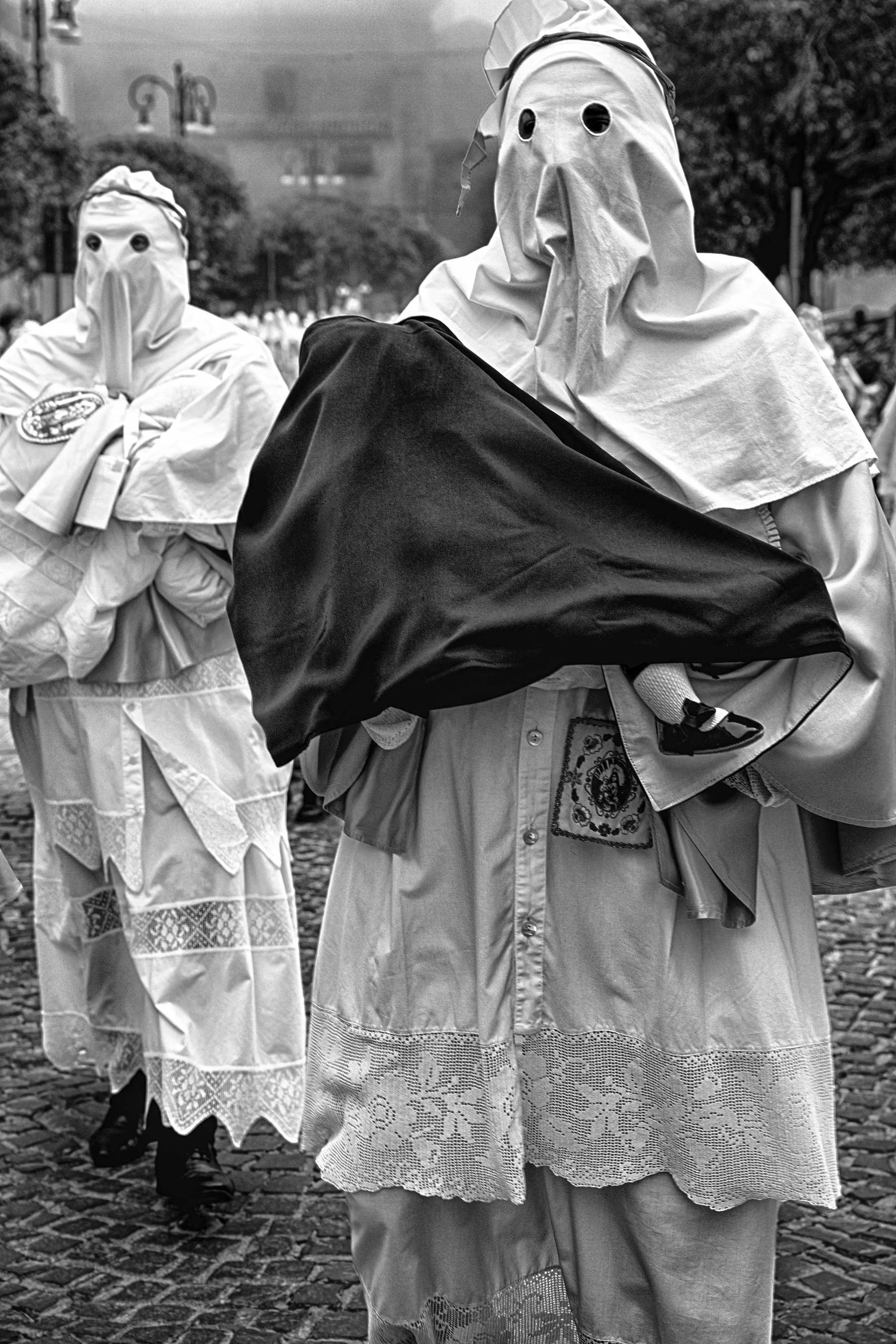
Monday’s Procession
Bearing a dear charge.
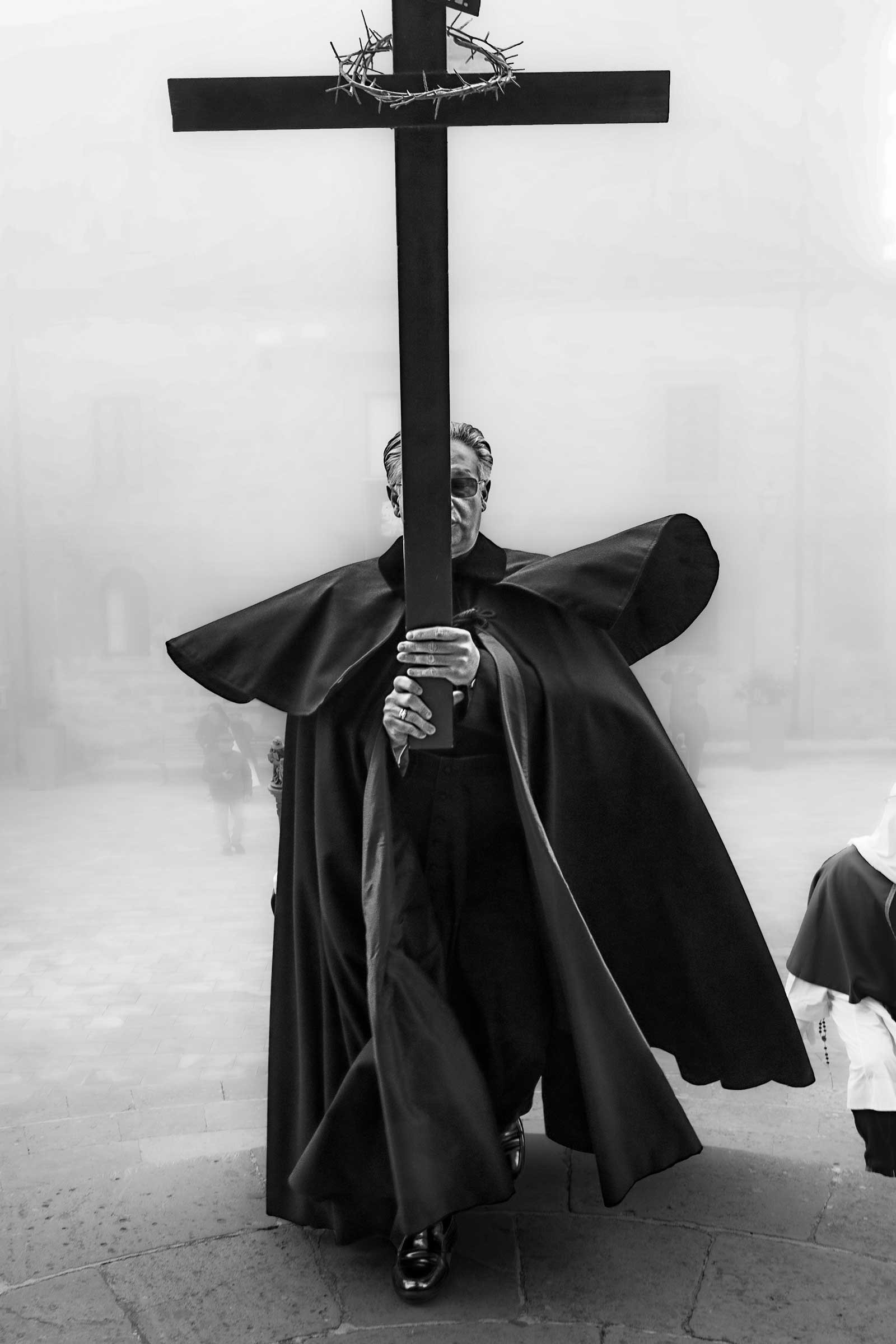
Solemn Advance
A priest ascends to the Chiesa Madre.
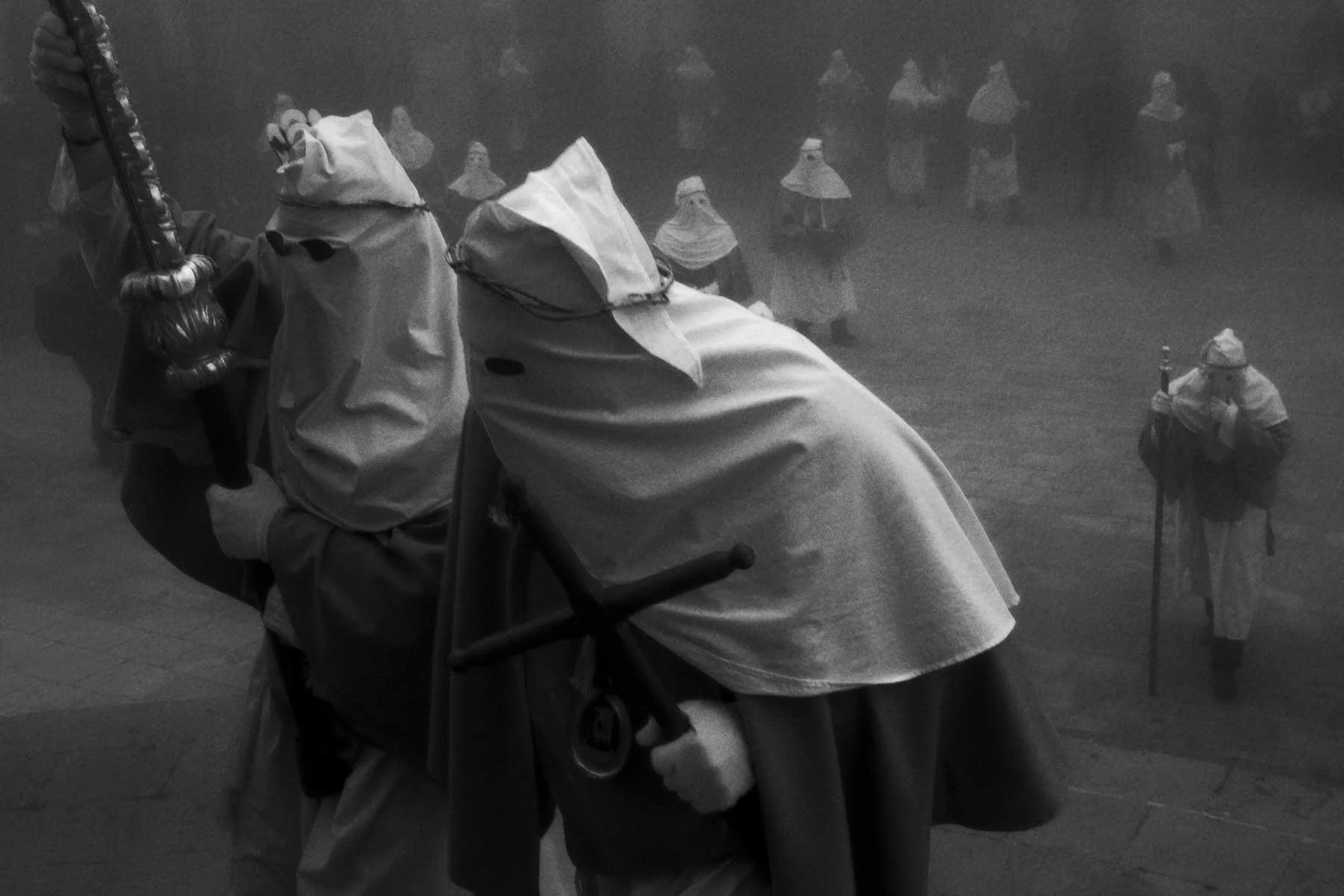
Ascending to the Chiesa Madre
In spring, fog often drapes the elevated city of Enna. On a cold and foggy morning, confratelli of the Maria Ss. Della Visitazione ascend to the Chiesa Madre.
HM: Do you see yourself as an observer or a participant?
MCC: I start as an observer. Always.
But over time, if you stay long enough, you become involved. You meet people, you build trust, you are invited into spaces.
Then you move from observation to participation but it must happen naturally.
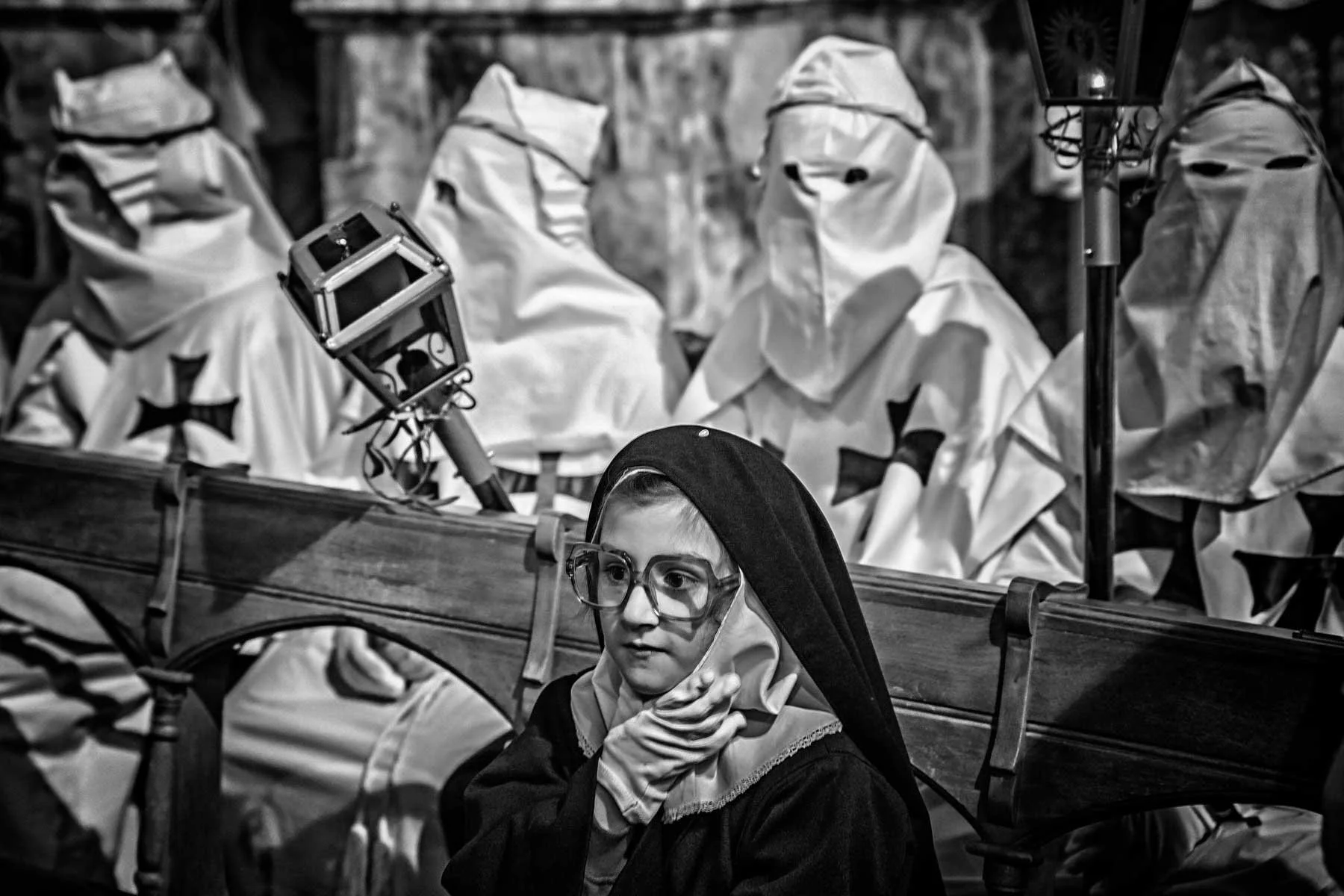
Large Glasses
A lump in her throat.
HM: You describe very different environments—structured rituals and chaotic celebrations. Which is harder to photograph?
MCC: Chaos is harder.
In structured situations, everything is controlled. The challenge is subtlety—finding the small details.
In chaos, everything happens at once. The challenge is to isolate meaning from confusion.
It requires speed, intuition, and a lot of patience.
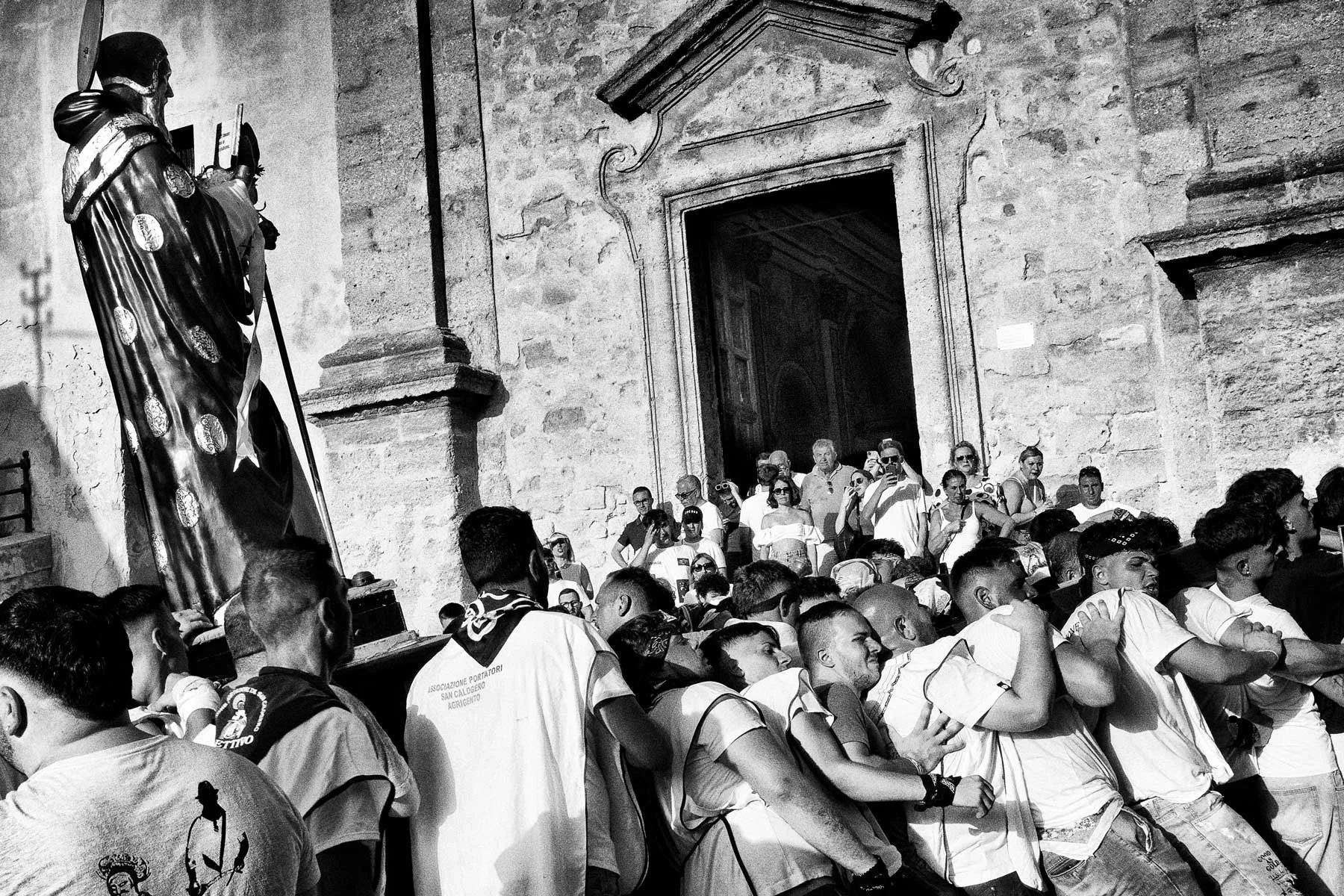
U Granni Sforzu
The bearers, straining under the nearly 1000 kg weight of San Calogero's statue, struggle to keep it balanced.
HM: What advice would you give to young photographers?
MCC: Be hungry.
You must be willing to take risks, not necessarily physical risks, but creative ones. You may spend hours, even days, without taking a meaningful photograph.
That is not failure. That is part of the process.
Also, anticipation is crucial. Photography is not only about reacting—it is about imagining what might happen next.
If you simply walk around hoping for a great shot, you will miss it. You need to observe, wait, and predict.
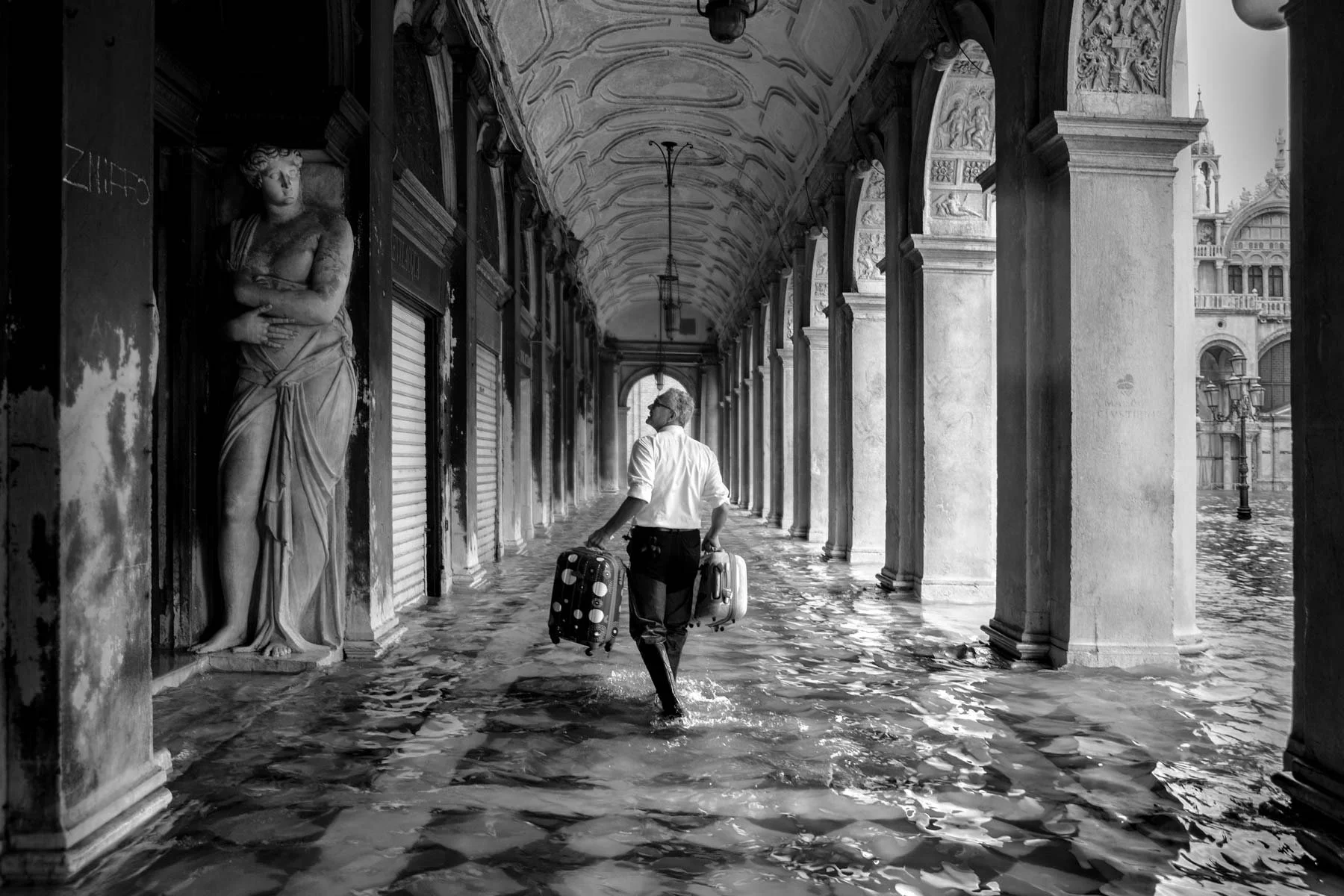
You Know it All
November 17, 2019
I arrived to an empty piazza San Marco. That man walked past me carrying the luggage of two isolated Japanese tourists, then he turned his head towards the old statue, perhaps asking for a sign of agreement. I had the impression that the statue returned a slight nod of his head.
HM: How do you know when a project is finished?
MCC: I rarely start with an end in mind.
I explore, I collect images, and over time something begins to take shape. At a certain point, the work feels mature and it can stand on its own.
But I never feel it is truly finished. There is always more to discover.
So it is not about completion, but about reaching a moment where the work can be shared.
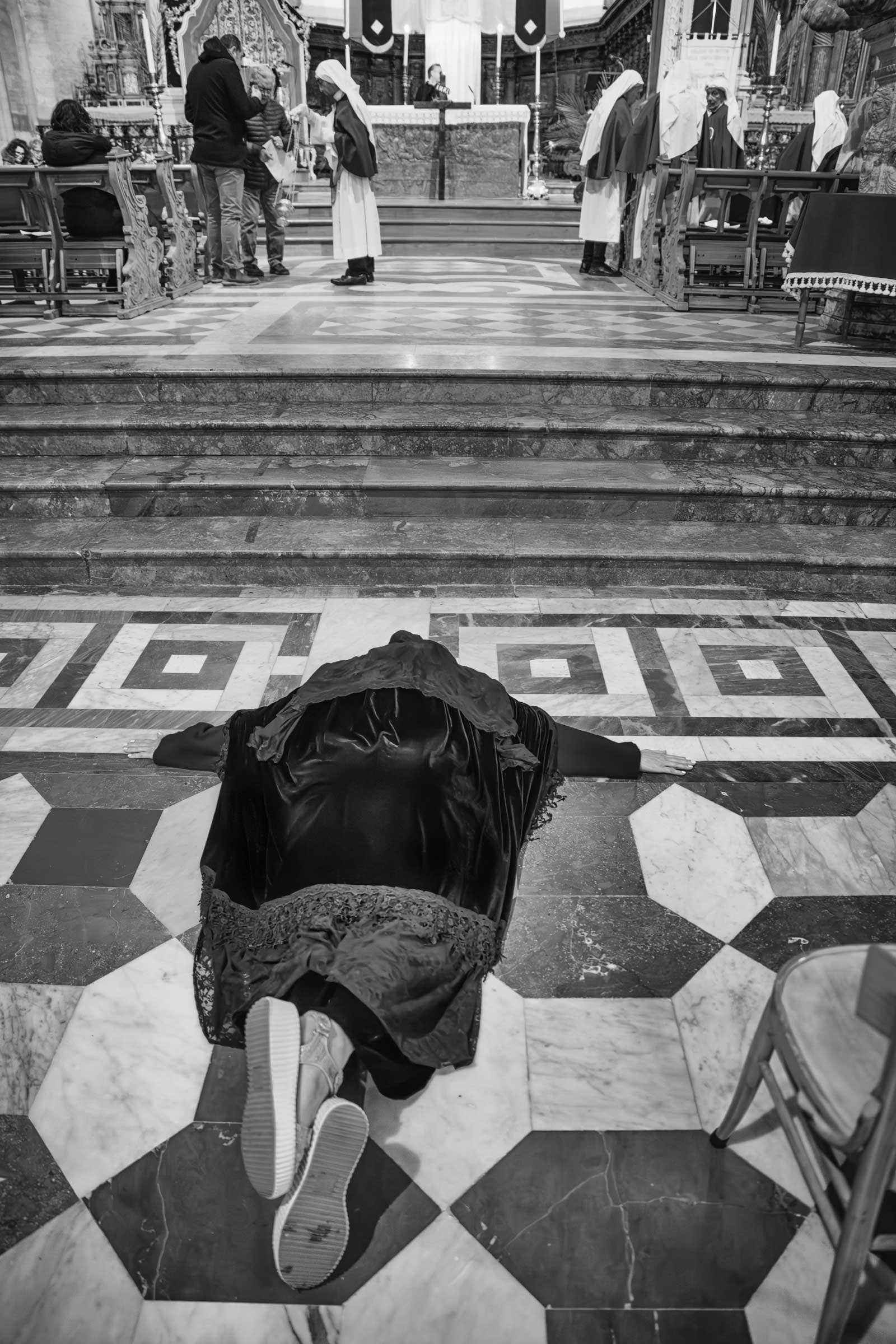
Devotion
During Holy Week, some believers experience the moment with profound intensity.
HM: What still drives you to pick up a camera today?
MCC: Curiosity.
There are always new places, new people, new situations. Even familiar environments reveal something new if you look carefully.
I am still searching not for answers, but for understanding.
As long as that remains, I will continue to photograph.
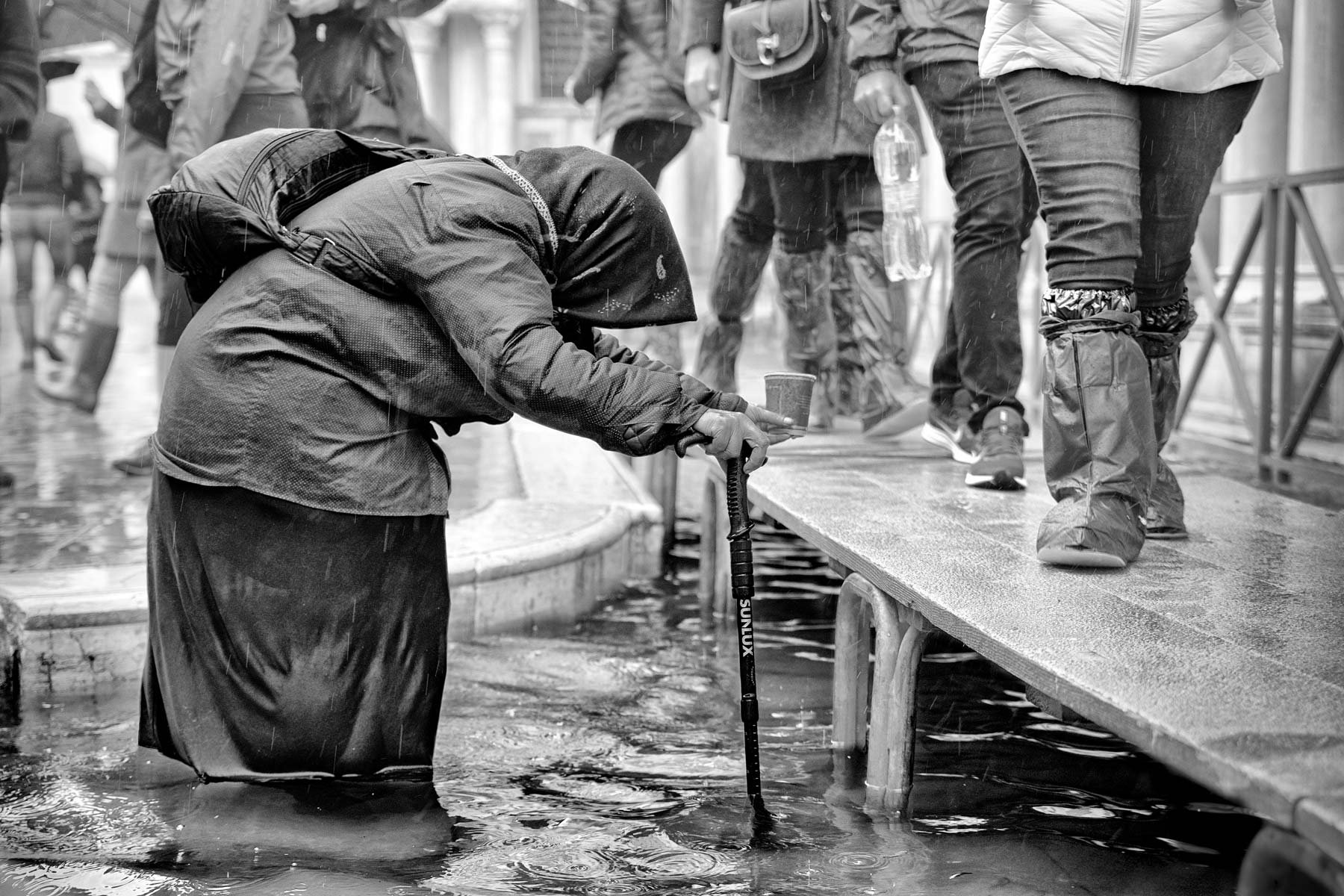
Seeking Alms
December 22, 2019
That old lady stood in the high waters for hours, looking invisible to most of the busy crowd.
HM: What's next for you?
MCC: In May I'll be going to Saintes-Maries-de-la-Mer, a small town in the Camargue, for what I'm told is the largest gathering of Roma people in the world.
They are devoted to Saint Sarah; during the festival the statue is carried into the sea and brought back. I don't yet know all the practices, but I've booked my trip. It fits the thread I've been following — religious festivals that sit right on the edge between the veneration of a symbol and the veneration of the object itself, which is where Christianity becomes very interesting.
These communities are formally Catholic, but they come from different parts of Europe, and their relationship to the sacred is not uniform. I’ll have to educate myself more before I go.
All images © Marco Claudio Campi